
1. Circular Economy and Life Cycle Assessment (LCA): Key Concepts
Circular Economy and Life Cycle Assessment (LCA) are considered as two complementary approaches that help family businesses rethink how resources are used throughout their operations. Rather than following the traditional “take–make–dispose” model, these approaches encourage businesses to reduce waste, improve efficiency, and consider environmental impacts at every stage of a product or service’s life. Together, they provide a practical framework for making more sustainable and informed business decisions.
What This Section Focuses On
- Moving beyond the traditional “take–make–dispose” business model
- Using resources more efficiently and keeping materials in circulation
- Understanding environmental impacts across the full life cycle of products
From Linear to Circular Thinking
Traditionally, many businesses operate using a linear model of production, where resources are taken, transformed into products, and then disposed of after use. While this approach has supported growth in the past, it leads to significant waste, higher costs, and increased pressure on natural resources. Circular thinking challenges this model by encouraging businesses to redesign products and processes so that materials remain in use for as long as possible.
Linear vs Circular Models
Linear:
Take → Make → Dispose

Circular:
Reduce
Repurpose
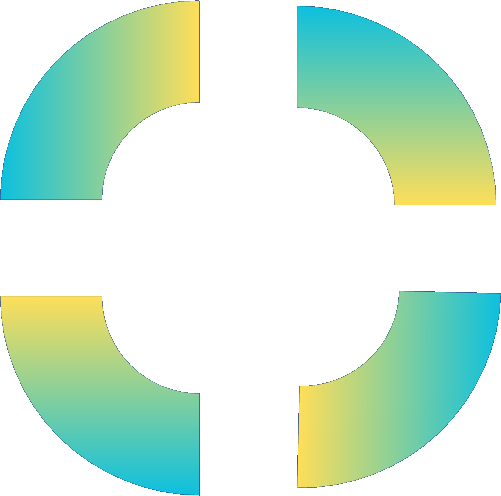
Reuse
Repair
Circular Economy in Practice
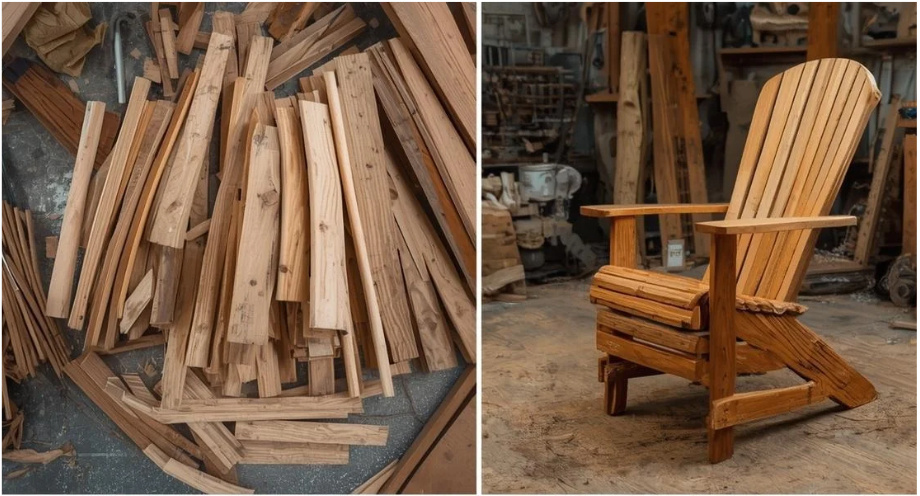
In this furniture workshop, circular economy principles are applied by rethinking how leftover materials and sourcing decisions are handled. Instead of discarding wood offcuts and damaged pieces, the business uses them to create smaller products such as shelves or
picture frames, reducing material waste and the need for new raw inputs. At the same time, the workshop prioritises sustainably sourced wood, including materials that do not contribute to forest degradation, ensuring that environmental responsibility is considered from the very beginning of the production process.
- Wood offcuts reused to produce smaller furniture items
- Partnerships with local businesses to repurpose unused materials
- Sustainable sourcing of wood and raw materials
Understanding Life Cycle Assessment (LCA)
Life Cycle Assessment (LCA) is a practical tool that helps businesses understand the full environmental impact of a product, from the extraction of raw materials to the end of its life. By assessing your products’ life cycles, you can spot opportunities to reduce energy and material use, minimize waste, and make decisions that benefit both your business and the environment. LCA empowers family businesses to take a holistic view of sustainability rather than tackling issues piece by piece.
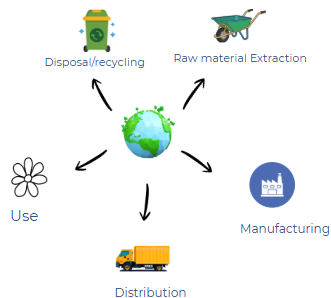
Look at the full life cycle of a product
Identify high-impact stages
Use simple LCA tools suited to SMEs
Compare materials, processes, or suppliers
Apply results to improve decisions
LCA in a Small Business
LCA in a Small Bakery that wants to reduce its environmental footprint:
Using a simplified LCA approach, they examine the life cycle of their bread: from sourcing flour and energy use in baking to packaging and disposal of leftovers.
They discover that switching to reusable packaging and optimizing oven energy use could significantly reduce waste and costs.
- Energy use in baking
- Packaging choices
- Waste from unsold products
Small improvements can make the business more efficient, responsible, and attractive to eco-conscious customers.
2. Business Benefits and Practical SME Examples
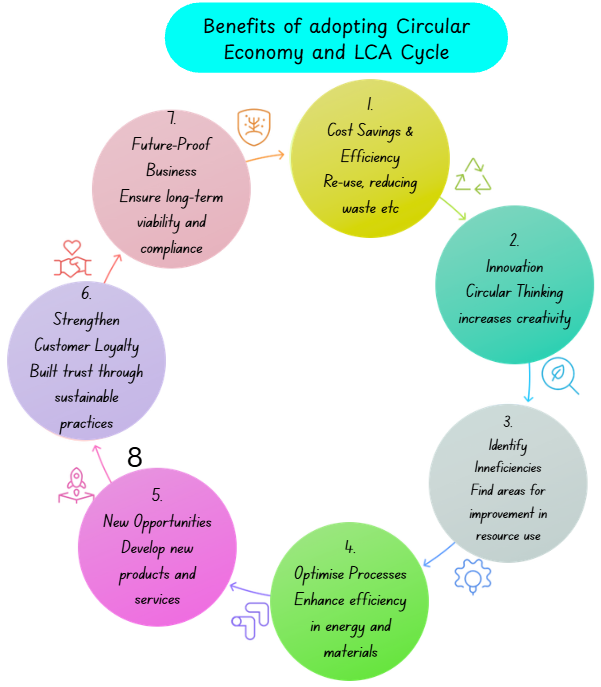
For family businesses , sustainability is about creating long-term value, resilience, and competitive advantage. Adopting Circular Economy principles and using LCA can help in several practical ways:
Why Circular Economy and LCA Are Important for SMEs
Circular Economy and Life Cycle Assessment help small and family businesses understand where resources are used inefficiently and where improvements can be made. By reducing waste and considering environmental impacts across the entire life cycle, businesses can improve performance while responding to growing sustainability expectations.
- Cost savings & efficiency: reducing waste and resource use lowers operating costs
- Innovation & new opportunities: turning by-products into new products or services
- Stronger reputation & trust: meeting customer expectations for responsible business
- Long-term resilience: preparing for future regulations and market changes
3. Applying Circular Practices: Exercise, Key Takeaways & Next Steps
Applying Circular Economy and LCA in Your Business
Understanding Circular Economy and Life Cycle Assessment is only the first step. The real value comes from applying these concepts to everyday business operations. Small, well-targeted changes can significantly improve efficiency, reduce waste, and strengthen long-term responsibility. The following example shows how a family-run SME successfully applied these principles in practice.
What Practical Application Involves
- Reviewing materials and processes for safer alternatives
- Using technology to reduce waste and improve precision
- Assessing energy and resource use to improve efficiency
Case Example: Kimonas Jewellery Workshop
Kimonas Jewellery Workshop, a family-run SME, applied Circular Economy and Life Cycle Assessment thinking by making targeted changes to its production process. The workshop replaced harmful cleaning chemicals with safer, environmentally friendly alternatives, improving employee safety and reducing environmental harm, even though this involved higher initial costs.
- Replaced hazardous chemicals with safer alternatives
- Improved working conditions and environmental performance
- Accepted higher short-term costs for long-term responsibility
To further improve efficiency, the workshop integrated 3D printing technology into its production process. This allowed for more precise material use, significantly reducing waste compared to traditional manufacturing methods. In addition, the business applied LCA thinking to energy use by investing in energy-efficient machinery and LED lighting, lowering its operational footprint and reducing costs over time.
Exercise: Identifying Opportunities for Improvement
This exercise helps you apply Circular Economy and Life Cycle Assessment thinking to your own business. You are not expected to analyse everything at once. Instead, focus on identifying one or two areas where small changes could reduce waste, improve efficiency, or lower environmental impact.
Step-by-Step:
- Materials and Processes: Identify materials, chemicals, or processes that may cause waste or harm.
- Waste and Resource Use: Consider where materials, energy, or resources are used inefficiently.
- Technology and Energy: Think about whether simple technology or energy improvements could help.
- One Action: Choose one realistic change you could start implementing immediately.
What small change could make the biggest difference in your business?
Key Takeaways
1
Circular Economy reduces waste and creates value
2
LCA helps identify where impacts matter most
3
Small changes can lead to significant benefits
4
Sustainability supports long-term competitiveness
5
Continuous improvement is essential
Next Steps and Conclusion
Sustainability is an ongoing process that supports efficiency, innovation, and resilience in family businesses. By gradually integrating Circular Economy principles and LCA thinking into daily operations, businesses can create value for both the organisation and the wider community.
Moving Forward
- Review one area of your business using circular thinking
- Implement at least one practical change
- Monitor results and encourage team involvement
4. Self-Assessment
5. Resources and Further Reading
- Resource 1: The first step towards circular economy is deeply human (Bodin, 2021) – TEDxtalk: youtu.be/3MKH07NMYJg
- Resource 2: Harvard Business Review – Sustainability and Innovation Articles on how small businesses can integrate sustainability practices to boost competitiveness. hbr.org/topic/sustainability
- European Commission – Life Cycle Assessment Provides detailed guidance on LCA methodology, tools, and applications for small and medium enterprises. ec.europa.eu/environment/eussd/smgp/lca.htm
6. References
- Bodin, S. (2021). The first step towards circular economy is deeply human [TEDx Talk]. YouTube. youtu.be/3MKH07NMYJg
- Ellen MacArthur Foundation. (n.d.). Circular economy. ellenmacarthurfoundation.org
- European Commission. (n.d.). Life cycle assessment. ec.europa.eu/lca.htm
- Harvard Business Review. (n.d.). Sustainability and innovation. hbr.org/topic/sustainability
- Netflix. (2024). Buy now: The shopping conspiracy [Film]. Netflix.
- OpenLCA. (n.d.). openLCA software and tutorials. openlca.org
- SWITCH-Asia Programme. (n.d.). Accelerating the transition to a circular economy through knowledge generation, management and sharing. switch-asia.eu/our-work/multi-country/accelerating-the-transition-to-a-circular-economy-through-knowledge-generation-management-and-sharing
- United Nations Environment Programme. (n.d.). Eco-innovation for SMEs. unep.org/eco-innovation
- United Nations Environment Programme & SWITCH-Asia. (n.d.). Circular economy toolkit for SMEs. switch-asia.eu/resource/circular-economy-toolkit-smes