
1. Key Concepts
Who Contributes to Creating a Roadmap?
- Family and owners – set the long-term vision: “where we want to go and what we want to pass on to the next generation.”
- Management and employees – translate the vision into specific projects and measures.
- External partners – consultants, banks, funding agencies, technology providers who deliver know-how and solutions.
- Community and customers – indirectly influence the roadmap, as their expectations and needs determine what is important for the company to communicate and implement.
What Does a Roadmap Look Like?
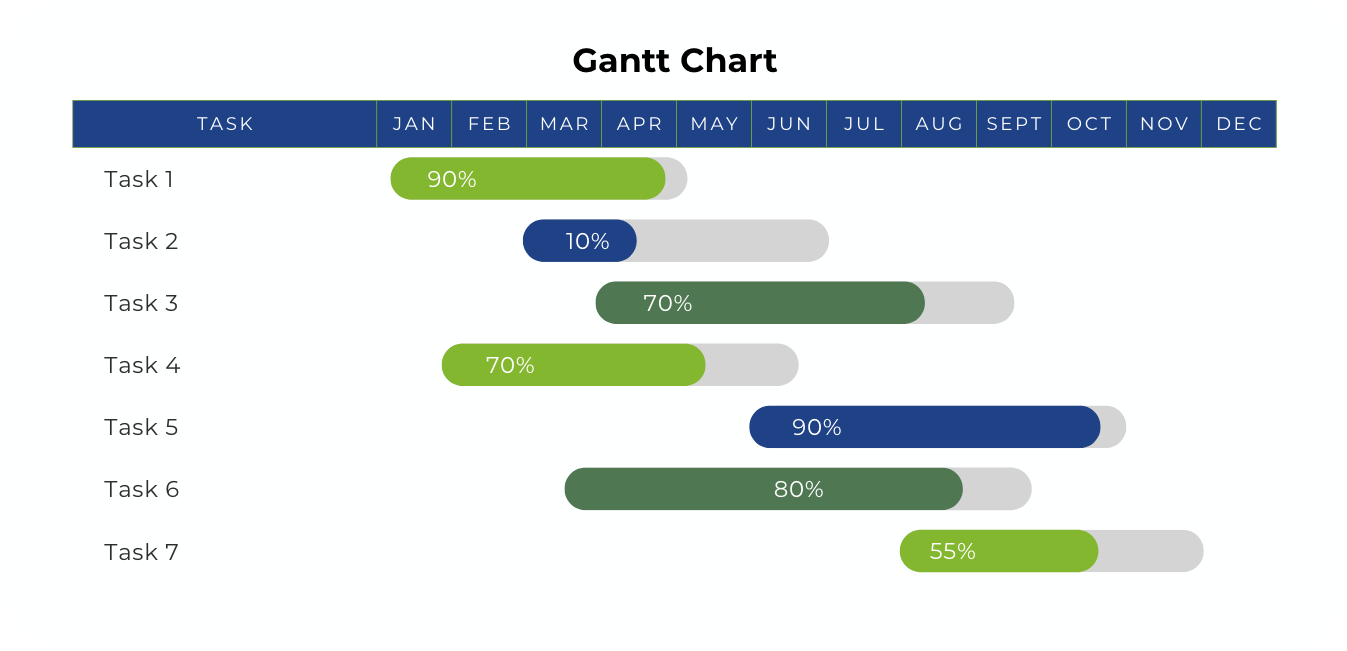
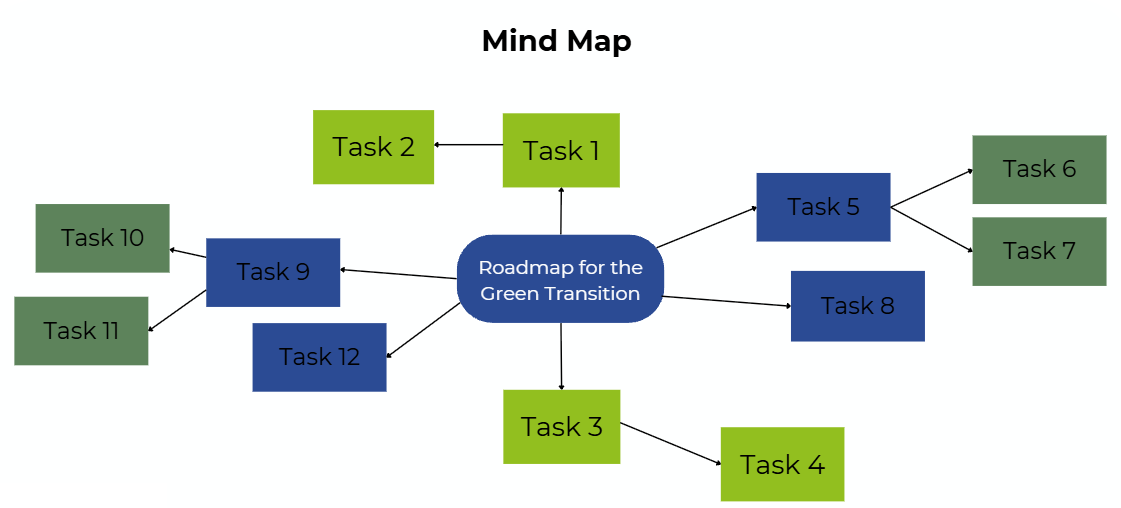
It can take the form of a timeline (e.g., 12–36 months), a Gantt chart, or a mind map. It lists specific projects (from quick wins to long-term investments), assigned roles and responsibilities, and sets measurable metrics and KPIs for success (e.g., CO₂e, % of recycling, MWh saved).

Tools for Creating a Roadmap
Traditionally, roadmaps were drawn on boards or in presentations. Today, there is a wide range of digital and modern tools that make visualization and collaboration easier, such as:

Excel / Google Sheets
simple starting point, clear table of steps, milestones, and budgets

PowerPoint / Canva
visual format, easy to share within the family and company

Trello, Asana, ClickUp
project management apps that allow task assignment, deadline tracking, and live roadmap updates
AI assistants
simulate scenarios (e.g., ROI of solar investments, CO₂ savings)
Interactive dashboards (Power BI, Tableau)
show in real time how the company is meeting ecological targets
Miro, MURAL
digital whiteboards where the family and team can co-create the roadmap and visualize scenarios
Mobile apps
allow employees to see the impact of their work (consumption, savings, recycling)
Specialized ESG/renewables tools
e.g., Sphera, Plan A, Sweep, which track carbon footprint, emissions, and the impact of individual steps
Collaborative platforms
family businesses can share roadmaps and experiences within associations and business networks
Example of a roadmap created in Microsoft Excel:
| Month | Activity | Responsibility | Measurable Goal | Expected Costs |
|---|---|---|---|---|
|
0-3 |
Baseline analysis (consumption, |
ESG coordinator / |
Report with baseline data
prepared |
€2,000 – €4,000 |
|
2-6 |
Definition of vision and goals |
Family council + |
Ecological mission in one |
Internal |
|
3-12 |
Quick wins (LED, heat recovery, |
Technical director + |
10% reduction in energy |
€20,000 – |
|
12-24 |
Strategic projects (PV installation, e- |
Project manager + CFO |
Installation of 250 kWp PV, |
€200,000 – |
|
24-36 |
Expansion and partnerships |
CEO + partnership with |
Join an energy community, |
€80,000 – |
|
0-36 |
Measurement and reporting (KPI, |
ESG coordinator + |
Annual ESG report, KPI |
€8,000 – |
7 Key Steps in Creating a Roadmap
Creating a roadmap is not a one-time task but a gradual process that guides a family business from the initial analysis to the long-term engagement of all key actors. Each step has its own logic and builds on the previous one – from mapping the baseline situation, defining visions and goals, setting milestones and financing, to clear roles, measuring success, and communicating with stakeholders. Only when these steps are interconnected does a functional and realistic roadmap emerge.
Step 1: Baseline Analysis
Baseline analysis is the first step toward creating a realistic roadmap. Without understanding the current state of company’s performance across the transition areas (like energy, production, packaging, relationship to the landscape, company culture, and community communication), it is impossible to set goals or track progress. Only when we know where we stand today can we responsibly determine where we want to go tomorrow. Baseline data serve as a benchmark – they allow us to compare future savings and improvements. They also help identify “quick wins” as well as strategic investments.
Areas to Analyse (Internally vs Externally)
| What we can handle internally (DIY approach) | Where it is advisable to involve external experts |
|---|---|
|
Energy – basic overview of consumption from invoices and meters, |
Detailed energy audit – certified auditors can identify specific savings |
|
Transport – inventory of the vehicle fleet, evaluation of average fuel |
Carbon footprint calculation (CO₂e) – especially Scope 3 (emissions in the |
|
Production and operations – mapping of waste streams, recording |
Technological production audits – e.g., measuring machine efficiency, |
|
Products and packaging – list of materials used, checking |
Eco-design of products and packaging – consultants can design circular |
|
People and culture – surveys among employees and family, internal |
Governance and ESG reporting – an external facilitator or consultant |
|
Community and the public – simple overview of activities |
Environmental projects in the landscape – cooperation with NGOs or |
Methods and Tools to Use
- Energy and environmental audits
- Calculation of the carbon footprint (CO₂e) – Scope 1, 2, 3
- Mapping of processes and material flows
- Surveys among employees, family members, and the community
- Benchmarking (comparison with the industry)
Concrete Examples of Real Companies across Europe
| Company | Green Transition Activity (RES) | Steps to Analyse the Baseline Situation |
|---|---|---|
|
Delfy (CZ) |
Installation of photovoltaic power plants (3×30 kW), heat |
Evaluation of electricity consumption, identification |
|
Mårdskog & Lindkvist |
More efficient warehouses (heat recovery) + biogas trucks |
Monitoring of temperature and consumption, logistics |
|
Elektrofink (DE) |
New production plant with 160 kW PV |
Energy audit, consumption scenarios, capacity |
|
Salvadori Arte (IT) |
Implementation of LED lighting + preparation for PV |
Analysis of gas and electricity consumption, cost |
Reflection Questions
- Do we currently have reliable data on our energy and gas consumption, emissions, waste, and packaging, or are we relying only on estimates?
- In which areas can we perform the analysis ourselves, and where do we need external support?
- What are our biggest “information gaps” (e.g., Scope 3 emissions, waste management, community impacts)?
- Are our data comparable with industry benchmarks? If not, how will we supplement them?
- Who in the family or company will be responsible for collecting and updating this data?
Task for the Company
Select 3 key areas (e.g., energy, transport, packaging) and conduct a basic analysis:
- Gather available internal data (invoices, records, inventory).
- Indicate whether the data are accurate (hard) or estimated.
- Evaluate whether you can monitor this area internally or if external experts will be needed.
The outcome is a simple table “What we know – How reliable – Internal / External”, which becomes the foundation of the roadmap.
Step 2: Defining Vision and Goals
After the initial analysis, the next step is to set a vision and measurable goals. The vision answers the question “Where do we, as a family business, want to get to?” and the goals define “How will we measure it specifically and by when?” For the vision and goals to make sense, they must be formulated according to the SMARTER methodology. Every goal should be:
S
Specific
clearly defined (e.g., “reduce electricity consumption in the
office” instead of “be more ecological”)
M
Measurable
expressed in numbers or indicators (e.g., “by 20%”)
A
Achievable
realistic within the company’s resources
R
Relevant
aligned with the family’s vision and business strategy
T
Time-bound
with a clear horizon (e.g., “within 12 months”)
E
Evaluate
continuously monitored to check progress
R
Re-adjust
ready to be adapted according to
changes (technology, legislation, finances)
Practical Examples
- Vision: “To be an energy self-sufficient company with minimal dependence on external sources.”
- Short-term SMARTER Goal: “Within 12 months, increase in-house electricity production from PV by 10% through the installation of an additional 10 kW capacity.”
- Long-term SMARTER Goal: “By 2030, achieve 80% energy self-sufficiency through a combination of PV, storage, and heat pumps.”
Mårdskog & Lindkvist (SE) – Biogas and Transport
- Vision: “To reduce the carbon footprint of logistics services and maintain the reputation of a responsible family-owned wholesaler.”
- Short-term SMARTER Goal: “Within 2 years, replace 20% of the fleet with biogas-powered vehicles and reduce CO₂ emissions from transport by 15% compared to 2022.”
- Long-term SMARTER Goal: “By 2035, operate 100% of the fleet on electric or other zero-emission propulsion.”
Task for the Family Business
Use the results of your baseline analysis and select 2–3 priority areas (e.g., energy, transport, packaging).
- One vision (where we want to get to), and
- Two SMARTER goals:
- One short-term (within 12–24 months),
- One long-term (5–10 years).
Make sure the goals are:
- Measurable (numerical indicators),
- Realistic (costs/resources),
- Evaluable and adaptable (can be regularly assessed and adjusted if needed).
Discuss the proposals at the family council and include feedback from all generations.
Step 3: Milestones and Timeline
Defining a vision and goals is only the beginning. To ensure that the roadmap does not remain just on paper, it must be divided into specific milestones. Milestones are checkpoints on the timeline that help the company track progress, motivate employees, and respond to problems in time. For family businesses, it is important to set milestones in a way that reflects both short-term quick wins and long-term strategic projects.
How to Set Milestones?
Short-term (0–12 months)
01
quick wins that show results and build motivation (e.g., LED lighting, process digitalisation, water savings)
Medium-term (12–24 months)
02
investment projects with visible impact (e.g., PV installation, purchase of electric vehicles, new waste management system)
Long-term (24–36 months and beyond)
03
systemic changes and partnerships (e.g., entry into community energy, circular models, carbon neutrality)
- Milestone 1: Installation of an additional 10 kW PV within 12 months.
- Milestone 2: Acquisition of a 50 MWh storage system within 24 months.
- Milestone 3: Achieve 80% energy self-sufficiency by 2030.
- Milestone 1: 5 biogas trucks within 12 months.
- Milestone 2: Expand fleet by 20% with alternative-fuel vehicles within 24 months.
- Milestone 3: Fully zero-emission fleet by 2035.
Milestones can be expressed in a timeline or in a Gantt chart.
For smaller family businesses, the most practical format is a simple table: Milestone – Deadline – Responsibility – Success Indicator.
Reflection Questions
- What are the 3–4 most important milestones we must achieve to fulfil the vision?
- What can be implemented quickly and cheaply, and what requires long-term investments?
- How can we align the timeline with financial possibilities and family decision-making?
Task for the Company
You already have the analysis completed, the vision set, and the SMARTER goals defined.
Now create a timeline for 12–36 months, marking:
- Quick wins – activities within 12 months that can be
implemented immediately. - Strategic projects – investments within 1–3 years.
- Systemic changes – steps with a 5–10 year horizon.
For each milestone, add:
- a responsible person, and
- a measurable success indicator (KPI).
Step 4: Resources and Financing
Without securing resources and financial coverage, a roadmap becomes just a list of wishes. Every step of the green transition requires clearly calculated costs, resources, and financing options. For family businesses, decision-making is typically guided not only by financial logic (ROI, cash flow) but also by family values and a long-term horizon that goes beyond a single generation.
Financing for Family SMEs
Traditional Sources
01
Own Capital
Reinvested profit, savings, family capital
02
Bank Loans
Commercial loans, green loans with favourable terms
03
Subsidies and Grants
EU programmes, Modernisation Fund, Horizon, LIFE
04
Power Purchase Agreements
Long-term contract for renewable electricity supply
05
Leasing / ESCO Models
Energy services with performance guarantees, paid from savings
Alternative Sources
01
Energy Cooperatives
Joint investments with municipality / companies, shared benefits
02
P2P Financing
Reinvested profit, savings, family capital
03
Crowdfunding
Community financing, customers contribute to project
04
Green Bonds
Issuing company bonds for ecological projects
05
ESG Funds / Venture Capital
Investment funds focused on sustainable projects
06
Public-Private Partnership
Partnership with state/municipality for infrastructure projects
07
Partnership with Customers
Product/energy subscriptions, customers co-finance project
Reflection Questions
- What is the investment threshold that our family considers acceptable?
- Can we balance economic payback with ecological benefit?
- Are we ready to cooperate with partners (municipalities, other companies, banks) on larger projects?
- Do we have a backup plan if we fail to obtain a subsidy/loan?
Task for the Company
Choose 1–2 projects from your roadmap (e.g., PV, electromobility, circular packaging).
For each project, list:
- Estimated costs
- Possible financing sources (own, loan, subsidy, partnership)
- ROI (return on investment)
- Ecological benefit (e.g., CO₂e savings, MWh saved, water savings)
The output is a simple decision-making table to be used at the family council.
Step 5: Governance and Roles
The green transformation is not only about technology and finance but also about management and accountability. If it is unclear who decides, who controls, and who is responsible for fulfilling the roadmap, the whole plan risks stalling. Governance means setting up a decision-making structure in the family business that is transparent, effective, and sustainable in the long term.
Methods and Tools to Use
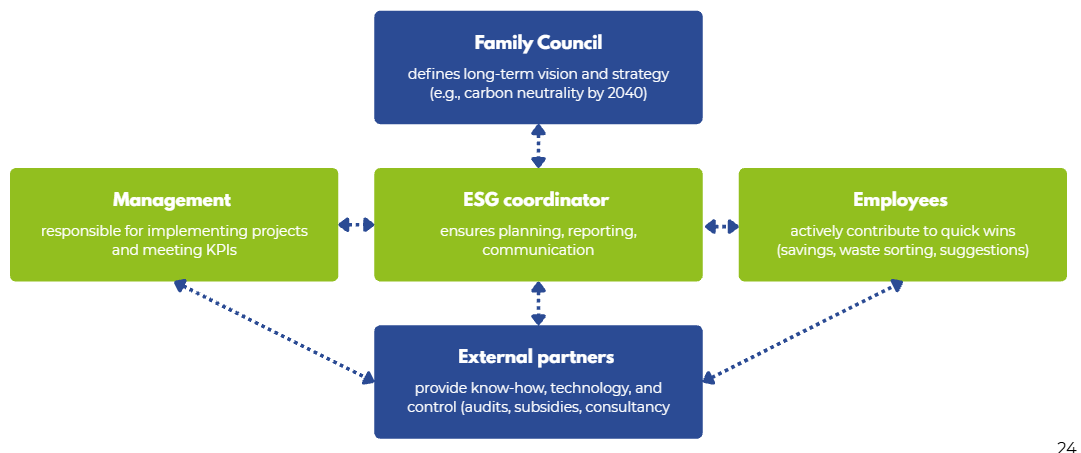
- Who owns the ESG / green transformation agenda? (e.g., ESG coordinator, technical director, family member entrusted with the agenda)
- What is the role of the family council? (long-term vision, strategic investments, family values)
- What is the role of management and employees? (operational steps, implementation of quick wins, internal communication)
- How to involve external partners and advisors? (auditors, subsidy specialists, technology providers)
- How to ensure continuity during generational transition? (clearly defined competencies, documented processes, reporting)
Recommended role distribution model
Reflection Questions
- Do we have a clearly assigned “owner” of the ESG agenda within the company?
- Are competencies between the family council and management properly divided?
- How are different generations of the family involved in decision-making?
- Do we have a system for regular reporting and monitoring?
Task for the Family Business
- Create a role map: who is responsible for each area of the roadmap (energy, mobility, waste, packaging).
- Appoint a main ESG owner (family member / ESG coordinator).
- Set up reporting: decide how often results will be presented to the family council and management.
- Discuss whether to involve external advisors (e.g., for certifications, subsidies, carbon footprint measurement).
Step 6: KPI and Measuring Success
“What does not get measured, does not get managed.” To ensure the roadmap does not remain just a list of activities, it must contain clearly defined KPIs (Key Performance Indicators). KPIs show whether the company is truly progressing toward its goals.
In family SMEs, KPIs need to be:
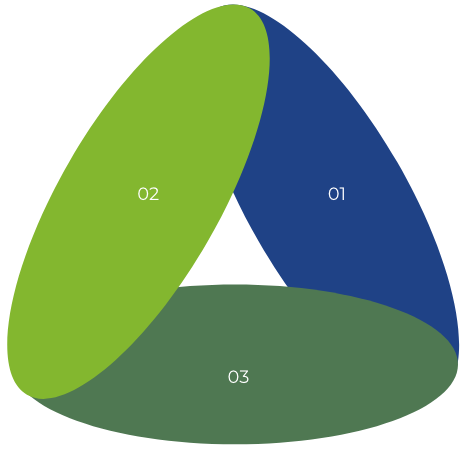
01
Financial
ROI, savings
02
Environmental
CO₂, waste, water, OZE share
03
Social
employees, community, reputation
And most importantly: understandable for everyone – from owners to employees.
What to Measure? — KPI Types for Green Transformation and Examples

Energy
annual consumption (MWh/year), % of energy from renewable sources, cost savings (CZK/EUR), % savings in energy costs, % reduction in electricity consumption
Mobility
% of EVs in fleet, % of fleet running on biogas, reduction of CO₂ emissions per km of logistics

Emissions
CO₂ emissions reduction from production (Scope 1, 2, 3) (ton/year), carbon footprint per unit of production

Products & Packaging
% of recycled materials, share of products with FSC/PEFC certification, reduction of single-use plastics

Water & Waste
% of recycling, % of drinking water replaced with rainwater, water consumption per unit of production, hazardous waste volumes

Governance & Culture
number of trained employees, number of employee eco-innovation proposals, ESG reporting (GRI/CSRD compliance)
Tools for Measurement and Reporting
Internal spreadsheets
(Excel, Google Sheets) – simple starting point
Goal Setting
(Power BI, Tableau) – clear real-time visualizations
Resource Gathering
(Plan A, Sweep, Sphera) – integrated data on energy, emissions, and finance
Implementation Strategy
GRI, CSRD, ISO 14001, Science Based Targets
Reflection Questions
- Which 3 indicators are the most important for us – economic, ecological, or social?
- Can we collect the data ourselves, or do we need external reporting software?
- How often will we evaluate KPIs, and who is responsible?
- How do we communicate KPIs to employees and partners – so they motivate rather than overload?
Task for the Family Business
- Select 5 KPIs that best reflect your vision and goals.
- For each KPI, specify:
- Unit of measurement (MWh, %, t CO₂e),
- Target value (e.g., “reduce by 20% by 2025”),
- Responsible person,
- Measurement frequency (monthly, quarterly, annually).
- Create a simple KPI dashboard (table or visualization) to be shared regularly with the family council and employees.
Step 7: Communication and Stakeholder Engagement
The success of green transformation is not measured only by achieving technical goals or financial returns. Another important factor is how results are perceived by different stakeholder groups – family, employees, customers, and the wider community. Only when all these pillars are engaged in the process does the roadmap become a true tool of change, not just an internal document.
The 4 Pillars of Success Evaluation – Family, Employees, Customers, Community
Each pillar – family, employees, customers, and community – has different expectations and a different timeline for recognizing changes. Family evaluates progress early during family councils and investment decisions. Employees begin to feel the impact once concrete measures enter daily operations. Customers react when new products or services appear. And community perceives success in the longer term, once the company consistently contributes to regional development. That’s why it is important to set up a regular cycle of evaluation and communication, showing progress both continuously and in the long run.
| Pillar | Reflection Questions | Indicators (KPIs) | Communication Formats |
|---|---|---|---|
|
Family |
Are goals aligned with family values? |
Family satisfaction with roadmap |
Family council meetings and minutes. |
|
Employees |
Do employees feel part of the |
% of employees trained in ESG/renewables. |
Intranet and newsletters. Workshops |
|
Customers |
Do customers perceive the company |
Growth in sales of eco-products/services. |
Marketing campaigns (storytelling, |
|
Community |
Do we contribute to sustainability in |
Number of community projects joined. Number |
Press releases, local media. Partnerships |
Practical Company Examples - DELFY
| Pillar | Reflection Questions | Indicators (KPIs) | Communication Formats |
|---|---|---|---|
|
Family |
Are investments into PV and heat pumps aligned with the long-term vision? Are younger generations involved in decision-making? |
80% energy self-sufficiency by 2030. Number of family members involved in projects (father + son). Number of family councils dedicated to ESG. |
Quarterly family meetings. Meeting minutes on investments. Family ESG workshops. |
|
Employees |
Do employees understand why digitalization and waste sorting are being introduced? Are they contributing their own ideas for savings? |
% of employees trained in sustainability (target: 100% by 2025). Number of improvement suggestions (target: 10 per year). |
Internal newsletters about savings. Company ESG training. Contest for best eco-idea. |
|
Customers |
Do customers perceive the company as sustainable? Are they willing to pay more for products stored with renewable energy? |
20% growth in sales of “green-stored” products. Number of positive customer reviews. |
Storytelling on website about PV and e-mobility. “ECO storage” label on invoices. Regular customer newsletters. |
|
Community |
Does Delfy contribute to regional development (e.g., educational events about photovoltaics)? How is the |
Number of community events (target: 2 per year). Media coverage in regional press. |
Company open days. Cooperation with local schools. Impact report published on website. |
Reflection Questions
- Can we clearly define today who our key stakeholders are (family, employees, customers, community)?
- Does each group perceive the benefits of our green transformation in the same way, or do their expectations differ?
- How do we currently gather feedback from stakeholders – and how do we use it?
- Are we prepared to communicate not only successes but also challenges and obstacles?
- Do we use appropriate communication formats for different groups (family council ≠ social media ≠ municipal council)?
Task for the Family Business
Create a simple stakeholder map (family – employees – customers – community).
For each group, add:
- What they expect from us (benefits, values, changes).
- How we will evaluate their satisfaction (KPIs, surveys, feedback).
- How we will communicate results to them (family council, intranet, newsletter, community events, social media).
Discuss within the family council whether our communication is balanced today – are we overlooking any pillar?
Final Thought
The green transformation of family businesses is not a one-off project but a long-term journey. A roadmap helps structure this journey and shows that even small steps matter if they lead to a clear vision. Every family business has its own values, traditions, and resources – and these can become the key to success. It’s not only about saving energy or reducing emissions, but about creating a legacy that future generations can be proud of and that will ensure stability over time.
2. Self-Assessment
3. Resources and Further Reading
- ESG News. (2025). ESG News – Sustainability News, ESG Investing, Events … ESG News.
A website full of current news, reports, and analytical articles on ESG trends, green technology, regulation, and
climate finance. Link to the website: esgnews.com - FamilyBusiness.org. (2025). Family Business – Improving entrepreneurship and family business effectiveness through research and sharing of best practices.
International portal with a rich database of articles, research, and case studies on family businesses, their values, succession, and sustainability. Link to the website: familybusiness.org - IMD – Institute for Management Development. (2024). How green are family businesses? By IMD.
Blog and research studies dedicated to how family businesses approach ecological transformation, including their specific advantages and challenges. Link to the website: imd.org. - Family Firm Institute (FFI). (2025). Family Business Review & FFI Practitioner.
Professional association with access to the peer-reviewed journal Family Business Review and practical newsletters focused on strategy, governance, and sustainability in family businesses. Link to the website: ffi.org. - Circular Economy Alliance. (2025). Circular Economy Alliance: Home.
A platform focused on education, knowledge sharing, and supporting the adoption of circular economy principles in businesses, including family firms. Link to the website: circulareconomyalliance.com - IESE Family Business Blog. (2025). The “S” in ESG: Social commitment in family business.
University blog reflecting on the role of social responsibility and values in family businesses, offering practical insights on the connection between ESG and family dynamics. Link to the website: blog.iese.edu/family-business3
4. References
- Espinosa Méndez, C., et al. (2024). ESG performance on the value of family firms: International evidence. Humanities and Social Sciences Communications.
- Domańska, A. (2024). Family firm entrepreneurship and sustainability initiatives: Role of women leaders as change agents. Business Ethics: A European Review.
- Hughes, M. (2025). ESG Essentials for Family Firms. Family Business Research Foundation.
- San Martín, Á. (2025, March 19). The “S” in ESG: Social commitment in family business. IESE Blog.
- Borsuk, M. (2024). Family firms and carbon emissions: A cross country analysis. Journal of Cleaner Production.