
1. Key Concepts
Impact Logic
Input
the resources we put into the project.
Example: an investment of EUR 200 thousand into a photovoltaic power plant.
Output
the direct products or services the project creates.Example: installed capacity of 250 kWp, annual production of 300 MWh of electricity.
Outcome
the changes that appear among target groups, in the short to medium term.Example: a 20% reduction in company energy costs, increased employee satisfaction thanks to modernization.
Impact
the long-term effect that goes beyond the project itself and contributes to broader goals.Example: reducing the company’s carbon footprint by 30%, strengthening the region’s energy self-sufficiency, enhancing brand reputation, leaving a legacy for the next generation.
A common mistake companies make is that they communicate only the inputs (“we invested in solar panels”) or outputs (“we installed the panels”), but fail to demonstrate the outcomes and impacts. Yet it is precisely at the impact levels that it becomes clear whether the green transition makes sense.
Typology of Impacts
The green transition is not one-dimensional. Every decision, every investment, and every project brings multiple layers of impact- from hard financial figures to intangible but equally important effects in reputation, values, or family cohesion. Typology of impacts therefore helps us see the whole picture – it shows that the green transition is a complex process affecting the economic, environmental, and social spheres.
Economic Impacts

Cost savings
reduced consumption of energy, water, materials

New opportunities
creation of new products or services (eco-packaging, green certifications)

Financial stability
lower dependence on energy price fluctuations
Access to finance
investors and banks now evaluate ESG criteria
Environmental Impacts

Reduction of CO₂e emissions
shift to renewables, electromobility, heat recovery
Resource savings
less water, less waste, more efficient production

Biodiversity and landscape
care for greenery, soil management
Circularity
extending product lifespan, minimizing single-use packaging
Social Impacts

Employees
reduced consumption of energy, water, materials
Family
strong intergenerational cooperation, shared values, pride in legacy and continuity

Community
the company as a “good neighbour”

Customers
trust and loyalty thanks to transparent communication
Reflection Questions
- Economic: Where have we saved costs in the past 3 years thanks to ecological measures? How could we quantify and present these savings (e.g., % reduction in consumption)?
- Environmental: How do we measure our carbon footprint and resource consumption? Are there areas where our company unnecessarily burdens nature without addressing it yet?
- Social:
- Do our employees perceive that the green transition improves their working environment? How can we involve the community so that our ecological steps are seen as a shared benefit?
- How do our family values (tradition, responsibility, legacy) influence decisions about ecological investments? What do we want to pass on to the next generation: just a profitable company, or also a legacy of sustainable business?
Task for the Family Business – “Impact Map of Our Company”
Choose one project (e.g., installation of photovoltaics, change of packaging, employee programme).
Divide the family into 3 groups – each assesses the project from a different perspective:
- Economic
- Environmental
- Social
Each group prepares 2 specific impacts (both positive and potential risks) and proposes 1 indicator to measure them. At the family council, combine the results into one clear table. Agree on which indicators will be monitored regularly – and who will be responsible for them. The outcome is a simple company “impact map” that clearly shows that one project has more than just a financial dimension.
Methods and Tools for Assessment
| Method / Tool | Description | Use for Family Business | Connection (quality / risk) |
|---|---|---|---|
|
KPIs and Dashboards |
Simple indicators (CO₂e, %recycling, energy savings). |
Quick overview, easy trend monitoring, employee motivation. |
“Check” in the PDCA cycle, basic
tool for risk monitoring. |
|
LCA (Life Cycle Assessment) |
Assessment of a product/service’s impacts across its entire lifecycle. |
Evaluation of environmental |
Identification of environmental risks in the supply chain. |
|
SROI (Social Return on Investment) |
Converting social benefits into |
Expressing the value of community projects or employee benefits. |
Helps decide on investments with long return horizons. |
|
ESG Reporting (GRI, CSRD, |
Standardised frameworks for |
Obligation and opportunity – |
Part of reputational risk prevention, “reporting” in risk management. |
|
Impact Map / Theory of Change |
Diagram of activities – outputs – outcomes – impacts. |
Clear visualisation of projects for family and employees. |
“Plan” in PDCA, linked to the risk identification phase. |
|
PDCA Cycle (Plan–Do–Check–Act) |
Continuous process of improvement. |
Every renewable energy or |
Connects quality management |
|
Risk Management Process |
Identification → Analysis → Evaluation → Response → Monitoring. |
Enables handling both threats and opportunities of the green transition. |
Linked with PDCA: risks are assessed in every cycle. |
|
Stakeholder Analysis |
Mapping how different groups evaluate impacts. |
Overview of the needs of family, employees, customers, community. |
Prevents conflicts (social and reputational risk). |
|
Scenario Analysis |
Modelling future variants (e.g., energy price growth, stagnation of renewables). |
Helps prepare the family business for different transition pathways. |
Classic tool of strategic risk management. |
|
Benchmarking & Best |
Comparison with leaders in the field or region. |
Inspiration, motivation, learning from others’ mistakes and successes. |
“Act” in PDCA – adapting processes based on better practice. |
Practical example - PDCA cycle (Plan–Do–Check–Act) Example of Community Energy
Plan
Energy consumption analysis agreement with the municipality definition of sharing goals
Do
Installation of batteries and meters pilot operation of sharing involvement of 5 companies and 20 households
Check
Saving and stability evaluation satisfaction questionnaires comparison with goals
Act
Protection expansion modification of contractual terms and conditions investment in additional capacity
Practical Example - SROI (Social Return on Investment)
A family-owned food company decided to invest in a school educational programme on healthy nutrition and ecology for children in the region. SROI shows that even a relatively small investment can have a multiplied social effect. A family business can therefore easily demonstrate to the community that their project has a deeper meaning – not only economic but also value-based.
Input: Investment of EUR 8,000 (materials, lecturer fees, school support).
Output: 300 children completed 10 lessons.
Outcome: 75% of parents reported that children brought new habits home (less food waste, more local produce). The school reduced single-use plastics in the canteen by 40%.
Impact: Strengthened reputation of the company as a “good neighbour.” Improved relations with the municipality (joint projects).
Calculated result: For every 1 EUR invested, a value of 3 EUR was created (savings, social benefit, positive PR).
Task for the Family Business
- KPI and dashboard
- PDCA cycle
- Impact map
- SROI, etc. (from the table above)
Apply it to your chosen project: define inputs, outputs, outcomes, and impacts, and try to express them in both numbers and value terms. Present the results at the family council. The goal is for the family to experience that these methods are not complicated and that they can clearly demonstrate the value of the green transition – even beyond the “ROI tables.”
Stakeholders and Their Perspectives
| What they expect: | How they assess impacts: | Indicators: | |
|---|---|---|---|
|
Family |
continuity, preservation of values, strengthening of family legacy |
less by short-term ROI, more by whether the investment fits into the family vision and lasts 20–30 years |
involvement of the next generation, existence of a family strategy, degree of consensus on values |
|
Employees |
better working conditions, safety, and opportunities to engage in meaningful projects |
by tangible improvements in everyday work and whether they can be proud of their company |
employee turnover, satisfaction survey results, participation in eco-programmes, reduced sick leave |
|
Customers |
fairness, transparency, and environmentally responsible products |
through concrete data (emissions, certifications, recycled materials) and authentic stories |
share of eco-products in sales, NPS (Net Promoter Score), number of customers citing ecology as a reason for purchase |
|
Community and Region |
that the company will be a “good neighbour,” support local projects, and contribute to a cleaner environment |
by visible results – whether the surroundings improve, and whether the company cooperates with municipalities, schools, and NGOs |
number of community projects, amount of investment in the region, feedback from local authorities |
|
Investors and Banks |
risk reduction, long-term returns, and credible ESG reporting |
using standardised indicators (ESG rating, CSRD compliance, carbon footprint) |
volume of green loans obtained, share of projects financed from ESG funds, results of external audits |
Specific Project Impacts
Family
Company perceived as a “good neighbour,” intergenerational agreement that the project makes sense beyond economics.
Employees
Higher loyalty, opportunities to participate in workshops (e.g., lectures in schools).
Customers
Stronger trust in the company’s products, brand linked to responsibility.
Community / School
75% of parents report behaviour change, 40% reduction in single-use plastics in the school canteen.
Investors / Banks
SROI = 3:1, positive PR, higher chance of green financing.
Reflection Questions
- Family – Do we have a clear agreement within the family on what we consider “success” in sustainability? Are our values really translated into concrete projects?
- Employees – How often do we give employees space to share their views on ecological projects? Are we able to turn their feedback into action?
- Customers – Do our customers perceive ecology as a reason to buy from us? Or are we not fully using this communication opportunity yet?
- Community – Are we visible as a “good neighbour”? Do we present our projects in a way that the municipality or school feels a real benefit?
- Investors / Banks – Could we demonstrate our environmental and social impacts in a way that would secure us better financing conditions?
Task for the Family Business – “Stakeholder Impact Audit”
Choose one specific project (e.g., installation of energy-saving technologies, new packaging, community support). Divide the family and key employees into groups – each group will “play” one stakeholder: Family, Employees, Customers, Community, Investors/Banks.
Each group prepares a short overview:
- What do they expect from the project?
- How would they measure its success?
- Which indicators are key for them?
Write everything into one common table (stakeholder impact map).
Discussion
Where are expectations aligned, and where could conflicts or differences arise?
The outcome is a practical stakeholder audit, showing the company whether its projects truly make sense for all key groups – and what needs to be improved in communication and impact measurement.
Challenges and Pitfalls of Impact Assessment
| Typical Pitfall | Risk | Example | How to Address It |
|---|---|---|---|
|
Greenwashing vs. Credibility |
Company reports only “nice numbers,” but fails to convince stakeholders of real impacts. |
Website says “we reduce emissions” but lacks concrete data or independent validation. |
Transparent reporting, use of
independent audits and data
validation, clear communication of
facts. |
|
Lack of Data and Measurability |
Some impacts (e.g., socio-emotional value) are difficult to quantify. |
Family feels pride and continuity, but there is no indicator that clearly captures it. |
Combine hard (numeric) and soft (surveys, feedback) indicators; start with pilot projects. |
|
Conflict Between Short-Term ROI and Long-Term Impact |
Founder demands quick payback, while successors seek a long-term legacy. |
A solar power plant with a 12-year payback is seen as too risky, even though it strengthens long-term stability. |
Hold family discussions about values; combine quick-win projects with long-term
investments. |
|
Different Stakeholder |
What the family considers success may not be shared by employees or customers. |
Customers expect eco-certifications, while the family communicates mainly values and tradition. |
Create a stakeholder map and regularly communicate results to each group in their own understandable language. |
|
Complexity and Bureaucracy |
Attempting to track too many indicators → overload and demotivation. |
Company collects dozens of KPIs, but no one actually evaluates them. |
Focus on 3–5 key indicators, track others only for orientation; use digital dashboards. |
How to Do It? Principles of Risk Management
According to ISO 31000 methodology and best practice, we can work with risks in impact assessment as follows:
Step 1: Identification
What risks are present? (e.g., customer distrust, invalid data, technological uncertainty)
Step 2: Analysis
What is the probability and what is the impact? (e.g., reputational damage can be significant even if the probability is low)
Step 3: Evaluation
Which risks will we accept, and which do we need to manage?
Step 4: Response
How will we respond: acceptance, mitigation, transfer, elimination
Step 5: Monitoring and Improvement
Risks evolve; they must be monitored and regularly evaluated
Practical Example - A Risk Map
A risk map visualizes main uncertainties that may arise during the implementation of your project. The example below shows a risk map of a food company that wants to start a new educational program.
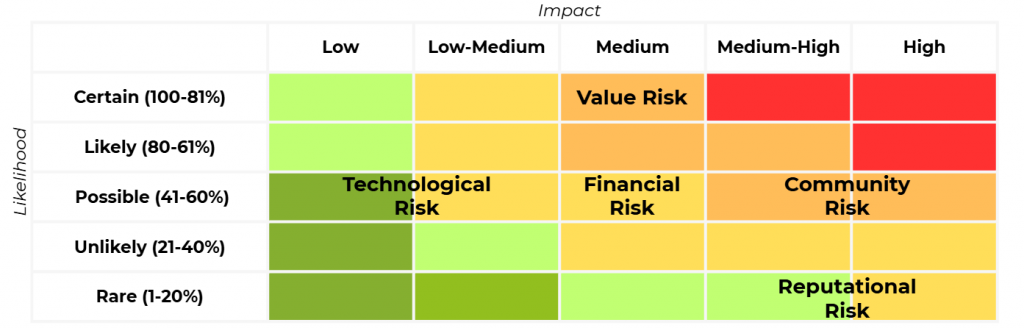
Axes of the Map
- X-axis – Impact (low, medium, high): How serious will the consequences be if it happens?
- Y-axis – Probability (low, medium, high): How often can the risk occur?
Color Zones
- Green = low risk (no major attention needed, just monitoring).
- Yellow = medium risk (requires preventive measures or ongoing monitoring).
- Red = high risk (must be actively managed, or the project adjusted).
Specific Risks (examples)
- Financial Risk
- Reputational Risk (greenwashing)
- Technological Risk (program evaluation)
- Value-based Risk (family disagreement)
- Community Risk (lack of interest from schools)
Reflection Questions
- How can we ensure that our communication about impacts is credible and transparent, and does not slip into greenwashing?
- Which impacts in our company are easy to measure (e.g., energy consumption), and which are difficult (e.g., pride, trust, cohesion)? How can we bridge this gap?
- How can we align short-term financial goals (ROI) with the long-term legacy for the next generation?
- Are all our stakeholders (family, employees, customers, community, banks) satisfied with how we present impact results to them? Who is “the most overlooked”?
- Are we collecting too much unnecessary data? Which 3–5 indicators should really be key for us?
Task for the Family Business: “Audit of Challenges and Pitfalls”
- Why is it relevant for our company?
- What specific real-life example relates to it?
- What measures can we take to mitigate the risk?
Record the answers in a simple “risk table” and discuss them at the family council. Finally, agree on 3 priority steps that will immediately improve the quality of your impact assessment. The outcome is a practical family action plan that will help the company avoid the most common pitfalls and increase the credibility of its green transition.
Impact Assessment of Corporate Communication of the Green Transition
Communication itself is one of the most important “impacts” of the green transition. The stakeholders must understand the ecological steps you are taking, trust them, and feel their meaning. Impact assessment of corporate communication therefore determines whether the company is truly strengthening trust and motivation, or whether there is a risk of greenwashing.

Employees
They see that their work has meaning and social impact, which increases motivation and loyalty.
Family
The advertisement strengthens the family’s pride that the company is not only an economic entity but also carries legacy and responsibility toward the region.

Customers
The advertisement builds trust and brand preference — people have a reason to choose the company’s products over anonymous competitors

Community and Schools
They perceive that the company actively contributes to the development of the region, which strengthens its reputation as a “good neighbour.”
Investors and Banks
They see a clearly communicated project with documented results → increasing credibility and making access to ESG financing easier.
Economic and Reputational Impacts of Communication
01
- Benefit: Better reputation attracts customers and makes access to financing easier.
- Indicators: Growth in sales of “green” products, number of media mentions, ESG rating.
- Example: The company transparently shares CO₂ data and thereby obtains a more favourable loan from the bank.
Social Impacts of Communication
02
- Benefit: Employees understand the purpose of the transition and feel pride.
- Indicators: Results of internal surveys, level of
participation in eco-projects. - Example: An internal newsletter explains the meaning of each investment — employee turnover decreases.
Impacts on Customers and the Community
03
- Benefit: Customers and the community trust the brand and perceive it as a “good neighbour.”
- Indicators: NPS (Net Promoter Score), share of customers citing ecology as a reason for purchase, feedback from the municipality.
- Example: A family-owned brewery presents its tree-planting project — the community strengthens loyalty, and customers identify more with the company.
Task for the Family Business: “Audit of Communication Impacts”
Choose three specific communication activities of your company (e.g., press release, social media post, internal newsletter, etc.). Evaluate them from the perspective of stakeholders (family, employees, customers, community, bank). Answer:
- Are the messages understandable?
- Are they supported by concrete data or only by slogans?
- Do they give stakeholders a sense of trust and meaning?
Create a table assessing the impacts of communication and propose 2–3 steps for improvement.
Final Thought
Impact assessment is not just a technical tool but above all a way to give meaning to the entire green transition. Family businesses, thanks to their values and long-term perspective, have a unique opportunity to show that success is not measured by financial results alone. Equally important are environmental benefits, social cohesion, customer trust, and reputation in the community. “The true legacy of a family business is not counted only in numbers, but in the kind of world it leaves to its children and the community in which it operates.”
2. Self-Assessment
3. Resources and Further Reading
- ESG News. (2025). ESG News – Sustainability News, ESG Investing, Events … ESG News.
A website full of current news, reports, and analytical articles on ESG trends, green technology, regulation, and
climate finance. Link to the website: esgnews.com - FamilyBusiness.org. (2025). Family Business – Improving entrepreneurship and family business effectiveness through research and sharing of best practices.
International portal with a rich database of articles, research, and case studies on family businesses, their values, succession, and sustainability. Link to the website: familybusiness.org - IMD – Institute for Management Development. (2024). How green are family businesses? iBy IMD.
Blog and research studies dedicated to how family businesses approach ecological transformation, including their specific advantages and challenges. Link to the website: imd.org. - Family Firm Institute (FFI). (2025). Family Business Review & FFI Practitioner.
Professional association with access to the peer-reviewed journal Family Business Review and practical newsletters focused on strategy, governance, and sustainability in family businesses. Link to the website: ffi.org. - Circular Economy Alliance. (2025). Circular Economy Alliance: Home.
A platform focused on education, knowledge sharing, and supporting the adoption of circular economy principles in businesses, including family firms. Link to the website: circulareconomyalliance.com - IESE Family Business Blog. (2025). The “S” in ESG: Social commitment in family business.
University blog reflecting on the role of social responsibility and values in family businesses, offering practical insights on the connection between ESG and family dynamics. Link to the website: blog.iese.edu/family-business3
4. References
- Jaffe, D. (2020). Borrowed from Your Grandchildren: The Evolution of 100-Year Family Enterprises. Wiley.
- Miller, D., & Le Breton-Miller, I. (2011). Managing for the Long Run: Lessons in Competitive Advantage from Great Family Businesses. Harvard Business School Press.
- Kraus, S., Clauss, T., & Kallmuenzer, A. (Eds.). (2023). Research Handbook on Family Business. Edward Elgar Publishing.