
1. Key Concepts
Main Advantages of Communication
01

Building trust and transparency
Customers and the community trust a company that openly
says what it is doing, why, and with what results — this helps
prevent suspicions of “greenwashing.”
02

Motivation and employee engagement
People feel part of the change when they understand its goals; they are more likely to contribute ideas and innovations.
03

Support for customer loyalty
Consumers prefer value-driven brands; ecological communication strengthens competitiveness.
04

Stronger relationships with suppliers and partners
Clear communication enables sustainable cooperation and joint initiatives.
05

Improved reputation in the community and society
Being a ‘good neighbour’ strengthens media and stakeholder perception
06

Creating a unifying vision
Communication helps bridge generational differences within the family and unites stakeholders around a single ecological mission.
07

Easier access to finance and support
Banks, investors and grant
programmes value clearly
communicated ecological
actions.
What topics will the communication cover?
When people think of the green transition, they often imagine solar panels or electric vehicles. In reality, it includes many activities that change how companies, families, and communities operate. To communicate it effectively, it is important to understand its main areas and activities:
1. Energy and energy consumption
- Renewable installations (PV, wind, heat pumps)
- Energy storage (batteries, hydrogen)
- Green electricity procurement (PPAs)
- Energy management
- Consumption reduction (LED, heat recovery, digitalization)
2. Transport and mobility
- Shift to electric vehicles or CNG/biogas.
- Building charging infrastructure.
- Shared transport, carsharing, cycling.
- Logistics optimization (shorter routes, efficient engines).
3. Production and operations
- Circular economy practices (recycling, material reuse)
- Waste as a resource (waste heat, biowaste)
- Water efficiency (savings, smart irrigation)
- Greener technologies and processes (lower emissions, less chemical use)
4. Products and packaging
- Certified materials (FSC, PEFC wood)
- Recycled or compostable packaging
- Reducing single-use plastics
- Eco-design of products (durability, repairability, upcycling)
5. Nature and landscape
- Tree planting and green area restoration
- Soil- and water-friendly land management
- Biodiversity support (meadows, insect hotels, bird boxes)
6. People and company culture
- Employee education on ecology
- Community and family involvement
- ESG strategies and targets (emissions, energy, waste, diversity)
- Incentive programmes for eco-innovation
7. Strategy and governance
- Long-term environmental goals (e.g., carbon neutrality by
2030/2040) - Monitoring and reporting KPIs (CO₂, energy use, recycling)
- Participation in grants and community energy projects
- Supplier standards and “no-go” investment rules
8. Community and public
- Cooperation with municipalities and schools on local ecological projects
- Support for community initiatives (cycle paths, gardens, educational events)
- Transparent communication about company environmental impacts
Only when we recognise that the green transition includes this whole bundle of activities can we think about how to communicate them effectively. Speak differently to family, employees, customers and suppliers, and choose the right media and channels.
Communication Within The Family
It’s useful to recall lessons from the SUFABU I educational materials. Practice shows that one common weakness in family businesses during generational change is communication – lack of open dialogue, misunderstanding between generations, or differing values and expectations. The same principles apply to green transformation: it’s not enough to make a technical decision (e.g., “we’ll install photovoltaics”) – the family must understand, accept, and be able to present it with one voice.
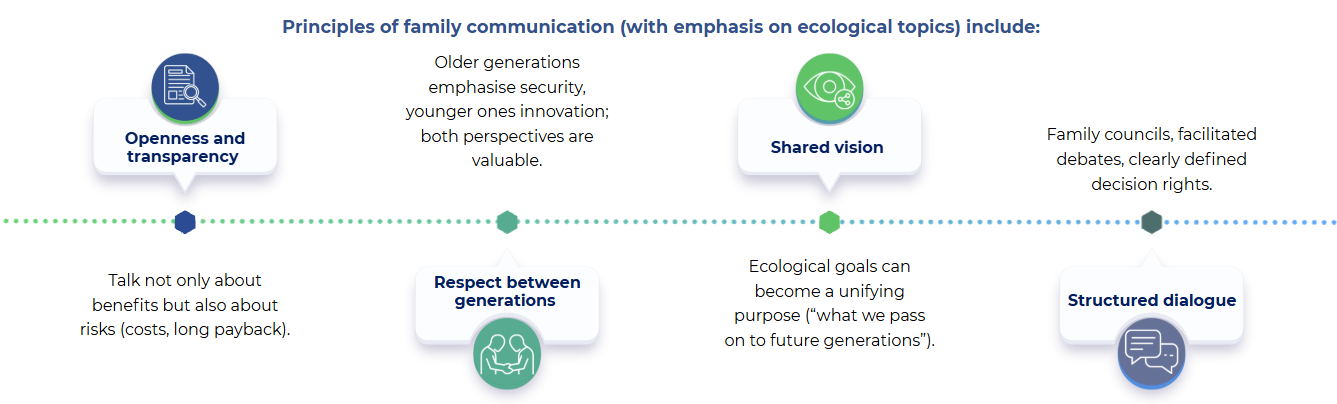
Internal family communication tools can include
01
Family Councils
meetings with a clear structure – agenda, minutes, decisions, responsibilities.
02
Family "huddle"
short regular meeting (e.g., 30 minutes focused on one ecological topic).
03
Family constitution or ecological code
a written statement of values, principles and boundaries (e.g., what we will never do because of environmental impact).
04
Third-party facilitation
an independent moderator or external expert if disputes are strong.
05
Less formal family gatherings
shared lunches, trips or informal chats where ecological topics can surface without pressure.
06
Digital tools and shared platforms
company drive (Google Drive, OneDrive), shared sheets or apps (Trello, Asana, Miro) to track projects, KPIs and ideas.
07
Family communication channel
e.g., a private WhatsApp/Signal group, or an internal Slack/Teams channel dedicated to ecological projects.
08
Visualisations and dashboards
overviews of energy savings, CO₂ or successful projects shared on the family intranet or screens in the company.
Practical example: Grupo El Castillo
Grupo El Castillo, a Spanish family-owned company in healthcare, real estate, and agriculture, aims to reduce resource use and improve environmental practices across its centres. The younger generation, especially Patricia, promotes greener habits such as less printing, waste separation, and introducing ISO 14001 in major centres.
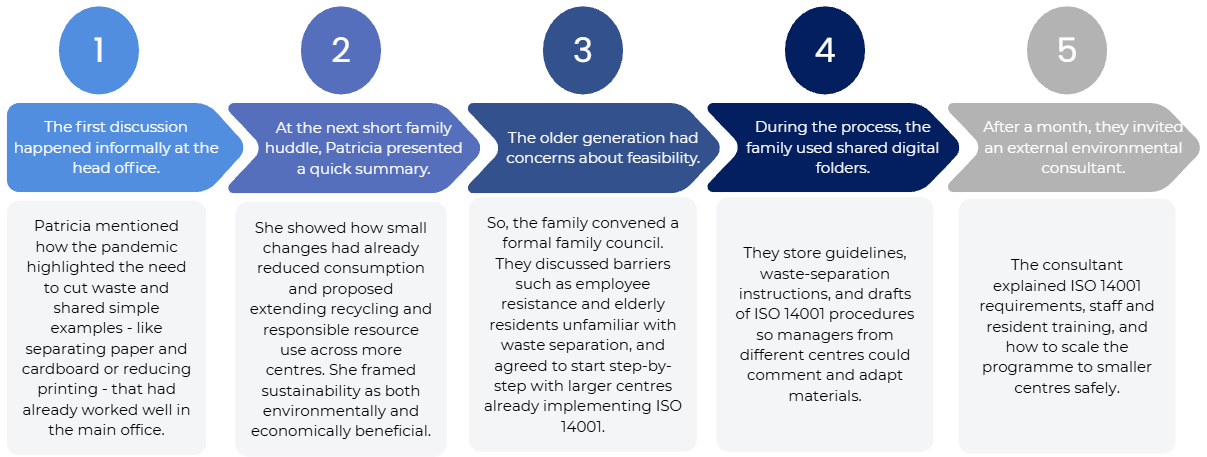
Through dialogue, structured meetings, and shared digital resources, the family agreed on a phased approach: start sustainability measures in the largest centres. This balanced the younger generation’s push for change with the older generation’s concerns about feasibility. Early pilot steps brought quick wins in resource savings and employee engagement, showing that green transformation often starts with cultural shifts and small daily practices rather than major technologies.
Questions for family reflection
These questions can be used as a working checklist at a family council or workshop. They can serve as the basis for starting a discussion on communicating the green transition internally and externally.
- What are we already doing?
- Which ecological activities are we already implementing (e.g., waste sorting, energy savings, digitalisation)?
- Which of these do we communicate externally, and which remain internal?
- Where do we want to head?
- Which sustainability activities do we want to develop in the next 10 years (e.g., electromobility, circular packaging, community energy)?
- How will different family generations be involved in deciding these steps?
- How will we manage the changes communicatively?
- What internal tools will help the family speak with one voice (e.g., family council, shared mission)?
- Which external channels should we strengthen (website, social media, local media, partners)?
- How will we measure success?
- How will we know our ecological communication works (employee engagement, customer feedback, community reputation)?
Task for the family
- Choose one ecological goal your company could realistically implement in the coming years (e.g., reduce electricity consumption, introduce smart sensors, save water, switch to greener packaging).
- Formulate the goal in one sentence: Example: “Within two years we will reduce electricity consumption by 10% through smart production control.”
- Divide family roles: Who will present the project, who will prepare documentation, who will oversee implementation?
- Choose appropriate communication tools: How will you open the topic (informal meeting)? How will you decide on it (family council, huddle)? How will you share information (digital platform)? Do you need a facilitator/expert?
- Propose the first three steps: What will you do within one month, within a quarter, and within a year?
- Write down a commitment: Create a short document (eco-code, minutes from the family council) so the goal and process are clearly captured.
This task can be completed during one family huddle (30 minutes). Its output will be a concrete ecological goal supported by a family decision and an agreed communication process.
Communication To Non-Family Stakeholders
1. Communication with Employees
Employees are key players in the green transition, as they are the ones who live with the consequences of the implemented measures every day. If they do not understand the purpose of the changes, they may perceive them as “extra obligations.” On the other hand, when they are informed in a timely and clear way, they see ecological measures as part of the company culture and can become ambassadors of change externally.
Good internal communication therefore strengthens trust and motivation, reduces resistance to new procedures, creates a sense of pride and co-responsibility, brings new ideas from people in practice, prepares employees for change and its process, and emphasizes the positives of the measures being taken.
Successful communication with employees in the context of the green transition is based on a balanced mix of traditional and modern tools, both formal and informal. Each tool has a different purpose and when combined, employees not only understand what is changing but also feel part of the process and bring their own ideas.

Formal traditional tools:
- Staff meeting – management explains the reasons for ecological measures and their expected impact.
- Training – practical workshops on new technologies or processes.
- Printed manual / notice board – short procedures, benefits and contact for support.

Informal traditional tools:
- Coffee with management – open discussion with employees about changes.
- Supervisor talks with shifts – explaining changes directly at the workplace.
- Company lunch – informal space to discuss sustainability initiatives.

Formal modern tools:
- Company intranet – section “Our Green Journey” with projects, results and FAQs.
- Dashboards on screens -visualisation of energy savings and results.
- E-newsletter – regular updates about ecological projects.
- Employee website section – materials, training videos and event calendar.
Informal modern tools:
- Teams/Slack group – employees share experiences and ideas.
- Short videos / reels – showing new technologies in practice.
- Gamification and competitions – teams suggest ideas for savings.
- Company bonuses – rewards for improvement proposals.
This example shows that a combination of formal and informal, traditional and modern tools ensures that ecological change is not only introduced but also embraced by employees as their own.
Reflection questions on communication with employees
- How regularly, and through which channels, do we inform employees about ecological measures?
- Do people have the chance to express their opinions or bring their own ideas — and are we ready to reward them?
- Is our communication understandable also for those without technical education?
- Do employees see results (in numbers and stories), or only hear promises?
- Are ecological goals linked to incentive programmes and bonuses?
Task for the company
- Choose one ecological activity currently being introduced (e.g., AI for energy savings, new packaging, waste sorting).
- Divide communication tools into two groups: traditional and online.
- Propose at least 2 tools from each group to inform employees about this activity.
- Decide how to involve employees in feedback and motivation (e.g., competition, bonus, intranet space).
- Create a short 3-month communication plan: who, what, when, how.
In this way, employees do not become just recipients of change but its co-authors and ambassadors.
Suggested text – Competition: Become an Eco-Ambassador!
Dear colleagues,
Our company has embarked on the path of green transformation – and you are its most important part. Every day you can contribute with your idea or small change to help us work smarter, more efficiently, and more environmentally friendly. That’s why we are launching a competition for the best ecological idea!
How to join?
- Think about where in your work unnecessary losses occur (energy, water, materials, time).
- Submit your idea via the intranet app EkoTip (icon on the homepage).
- Every month we will select the 3 most interesting proposals and reward them.
What can you win?
- A bonus in your paycheck of XY CZK
- A gift voucher of your choice
- The title “Eco-Ambassador of the Month,” published on the intranet and company notice board.
Don’t be afraid to come up with small improvements – those often bring the biggest savings! Together we can prove that our innovations are not only about technology but also about shared smartness and creativity.
Click on EkoTip and join today!
2. Communication with Customers
Today, customers closely watch how their suppliers and partners approach sustainability. It is no longer just about product quality and price, but also about brand values and ecological responsibility. If a company is able to clearly communicate its steps in the green transition, it gains trust and loyalty of customers, gives competitive advantage, provides new business opportunities and builds better reputation.
Forms of Marketing Communication
Every customer, every generation, and every target group has a different way of receiving information and seeking inspiration. While older customers may value a newspaper article or face-to-face meeting, younger generations expect quick visual communication on social media or short videos.
That is why companies need to use omnichannel marketing – combining traditional and digital tools so that they support each other and together create a single, coherent story and a unified corporate image. The omnichannel approach means that customers receive a consistent message whether they read a newsletter, visit the website, open LinkedIn, or see your product in a store.
The strength lies in synergy. Each form of communication reinforces the others, and only together do they build a complete picture of the brand as a responsible and modern family business.
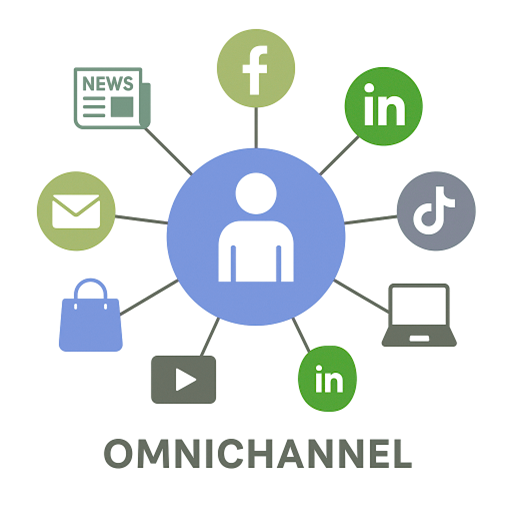
Traditional tools, e.g.

Press releases and articles in local or industry media.

Advertising in newspapers, radio, trade magazines.

Flyers, brochures, and eco-labels directly on product packaging.

Corporate events and open days focused on ecology.
Online and modern tools, e.g.

Website – a dedicated “Our Sustainability Journey” section with facts, KPIs, and stories

Social media – differentiated content:
- Facebook – emotional stories, employee and customer photos, joint events.
- LinkedIn – data, goals, B2B projects, partnerships, certifications.
- Instagram/TikTok – short videos and reels “behind the scenes”

Customer newsletter – regularly sharing updates and eco-milestones.

Product packaging with QR codes – linking to the story of the ecological innovation.

Video storytelling – a mini-documentary about the company’s green journey.
Practical example
- A company introduces AI and machine vision to reduce energy consumption. For customers, it became part of their brand story:
- On the website, they launched a section “Smart Production = Lower Footprint” explaining how AI reduces the carbon footprint of manufacturing.
- On LinkedIn, they shared an infographic with numbers: 15% energy savings, XY tons of CO₂ emissions reduced annually.
- On Instagram, they posted a short video from production where a technician shows the camera system and explains how it monitors efficiency.
- On product packaging, they added a QR code linking to the “How We Produce Sustainably” page.
- In the local press, an article was published: “Regional Family Business Saves Energy Thanks to Artificial Intelligence.”
Reflection Questions
- Is our ecological strategy visible on the website and social media?
- Are we able to communicate ecological steps to customers with concrete facts and numbers?
- Can we link the product with a story – so the customer knows their choice supports sustainability?
- How regularly do we inform customers about updates and results?
- Who is responsible for “green marketing” communication in our company?
Task for the company
- Choose one ecological innovation (e.g., AI in production, new packaging, water savings).
- Create a short story for the customer – what it means for them, not just for the company.
- Decide how you will share the story traditionally (e.g., article, flyer) and in a modern way (e.g., Instagram video, LinkedIn infographic).
- Define one measurable indicator to show customers (CO₂, % savings, recycling).
- Design visuals for communication in individual media.
Example – Storytelling Communication of a Family Business on Social Media
Family story
“Our grandparents always said we should treat the land and our work with respect. Today we are trying to bring this value into the 21st century – that’s why we introduced artificial intelligence into production. It helps us save energy and materials. Thanks to this, we can produce the same quality products with a smaller ecological footprint – for you and for future generations.”
Concrete fact – “AI has already helped us reduce energy consumption by 15% in the first half-year.”
Appeal to values – “We do this because we believe a family business has a responsibility – to people, to nature, and to tomorrow.”
Hashtags: #FamilyBusiness #GreenTransition #OurJourney
Conclusion
Communication is not a supplement to the green transition but its essential condition. Only when we can talk about ecological steps clearly, openly, and authentically do individual measures turn into a powerful story that strengthens trust inside and outside the company. The family gains a clear vision, employees gain motivation, customers gain a reason for loyalty, suppliers gain inspiration, and the community gains a partner it can rely on. Thus, the green transition stops being just a technological change – it becomes part of the identity of the family business and its responsibility to future generations.
2. Self-Assessment
3. References and Recommended Literature
Recommended Professional Portals and Resources
- ESG News. (2025). A site full of current news, reports, and analyses on ESG trends, green technology, regulation,
and climate finance. esgnews.com - FamilyBusiness.org. (2025). A great resource focusing on family business specifics: leadership, governance,
next-generation education, ESG strategies. familybusiness.org - Circular Economy Alliance. (2025). A platform supporting circular economy adoption with educational
programs, courses, and practical tools. circulareconomyalliance.com - STEP. (2022). Circular Economy Principles for Family Business and Wealth Stewardship: A New Governance and
Sustainability Framework. step.org - Family Business Association. (2025). Strategic Growth Through Values and Purpose – KPMG Family Business
Report. kpmg.com/global-family-business-report-2025.html
References and Recommended Literature
- Kotler, P., Kartajaya, H., & Setiawan, I. (2023). Marketing 6.0: The Future is Immersive. John Wiley & Sons.
- Aleksic, A. (2025). Algospeak: How social media is Transforming the Future of Language. Knopf.
- O’Leary, J. (2025, June). 5X: The Five Seismic Shifts that Will Reshape Communications and Marketing Over the Next Five Years. Weber Shandwick.
- TikTok. (2025, January). TikTok Breaks Down 3 Big Trends that Brands Should Watch for in 2025. Business Insider.
- DeWitt, D. (2025, May). Audience Engagement 2025. AV Network.
Research and Academic Articles
- Pearson, S., & Malthouse, E. (2024). Fifth Generation IMC: Expanding the Scope to Profit, People, and the Planet.
- Aghaei, R., Kiaei, A. A., Boush, M., Vahidi, J., Zavvar, M., Barzegar, Z., & Rofoosheh, M. (2025). Harnessing the Potential of Large Language Models in Modern Marketing Management: Applications, Future Directions, and Strategic Recommendations.
- Abboud, S., Hanna, E., Jeunen, O., Raheja, V., & Wheeler, S. (2025). Agentic Personalisation of Cross-Channel Marketing Experiences.