|

Sustainable Leadership

Module 7.

Sustainable Leadership

Takeaways

  • Identify the concept and role of sustainable leadership.
  • Define the required skills for successful sustainable leaders.
  • Understand the relevance of sustainable leadership for SME family businesses.
  • Integrate green values and responsible practices into the business leadership.

Aim of this module

This module aims to explain the concept and the pivotal role of sustainable leadership to ensure business continuity while balancing the well-being of employees and fostering innovation, adaptability and sustainable practices.

It is designed to support owners, managers, and current or future leaders of SMEs in understanding how sustainability can be integrated into strategic decision-making and organizational culture.

By embracing the principles of sustainability leadership and with the right combination of skills, perspectives and principles, sustainability leaders can guide SME family businesses with vision, adaptability and ethics toward a sustainable future that benefits people, the planet and the economy.

Introduction

Sustainability is a central focus for businesses worldwide as we collectively face pressing global challenges, such as climate change, resource depletion, and social injustices.

SME family businesses, often characterized by limited resources, have to cope with these new challenges. Several authors have shown a connection between leadership styles and business growth or survival (Tantry et al., 2025).

The demand for strategic sustainable leadership has never been greater, as companies recognize the need to balance economic growth with environmental and social responsibility.

The strategic importance of SMEs to job creation and the national economy of countries increases the need to explore sustainable leadership that may best ensure the survival and growth of smaller businesses.

We will analyze how sustainable leaders are responding to the challenges and opportunities of sustainability through real case studies and how to integrate green values and responsible practices into the business leadership through an interactive activity.

Contents of this module

Sustainable Leadership

Sustainable leadership has gained substantial importance in the last decade, since it prioritizes not only business success but also the well-being of employees, society and the environment, which is critical to ensure long-term business growth.

However, embracing sustainable leadership styles, characterized by agile decision-making, long-term resilience, and adaptive strategies, represents a challenge for SME family businesses.

Sustainable leadership combines sustainable development with leadership in order to guide organisations towards a healthy and responsible future focused on environmental, social and economic factors. It is a process of influence that comprises specific practices on personal, organizational and strategic levels, as explained in our video.

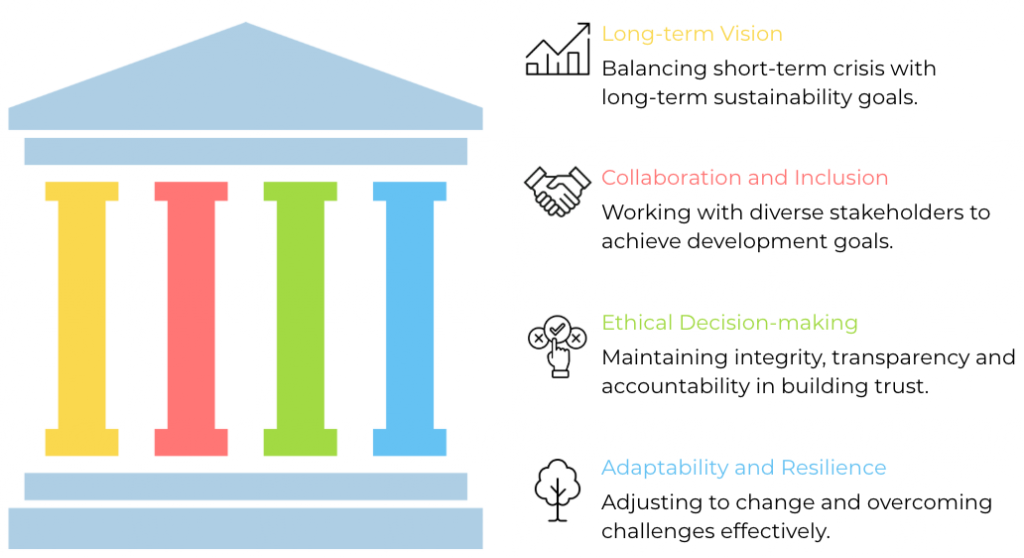
It goes beyond implementing sustainable practices; it involves inspiring mindsets, driving innovation, and empowering others to contribute to SDGs, as resumed and synthesized in four main principles, illustrated in Figure 1.

Figure 1

Based on these principles, we can detect the required skills for successful sustainable leaders.

First of all, sustainability leaders understand the connection of economic, environmental, and social factors and work to create a positive impact in all three areas. Therefore, they identify challenges, collaborate with diverse stakeholders, and develop strategies that lead to meaningful, measurable outcomes.

They encourage organizations and communities to rethink traditional models of growth and success, advocating for systems that prioritize the well-being of people and the planet.

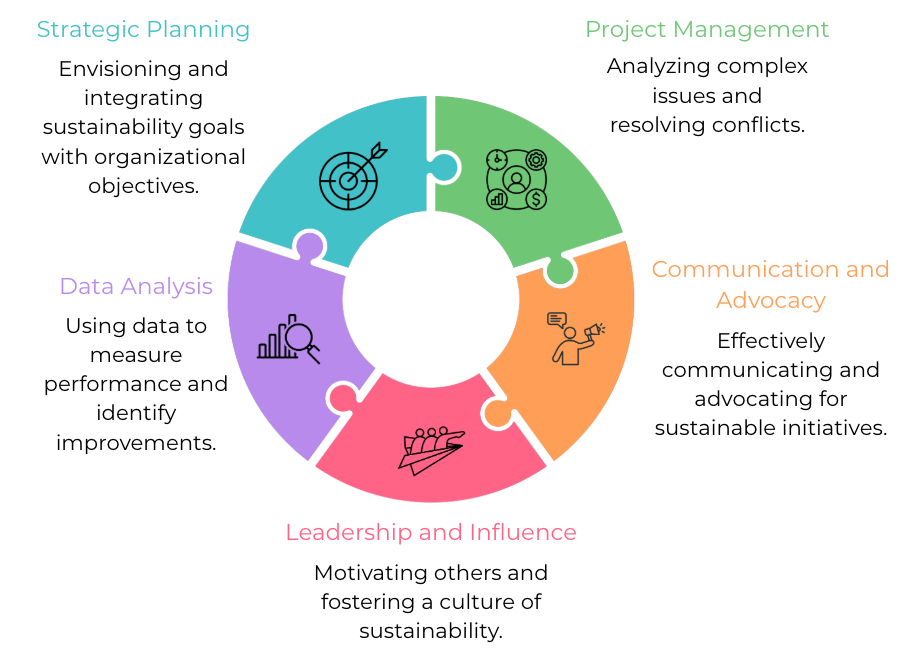
SME owners, managers and current or future leaders considering a role in sustainability leadership are encouraged to develop the key skills, represented in Figure 2.

Figure 2

Benefits

In order to adopt sustainable leadership, SME leaders must balance sustainability and profitability in equal measure.

Sustainable leaders focus on fostering a positive work environment, which increases team performance and improves creativity. Encouraging open communication and collaboration among team members helps create a supportive culture that attracts purpose-driven talents. This will allow SMEs to enhance their organizational performance and employee engagement and build a sustainable model company.

Seeking feedback, providing continuous learning and mentorship programs are keystones in sustainable leadership development, which will facilitate resilience and nurture growth and innovation in the company. In addition, delegating and empowering team members fosters trust, autonomy and ownership within the team. This will enhance organizational adaptability and ensure long-term survival in a challenging environment.

Case Study

In order to analyze how current SME leaders respond to the challenges of sustainability, we introduced the OMNI group in our video.

In Module I, we already mentioned Grupo el Castillo as a company case study. One of the biggest faced challenges is the resistance of elder members, tending to behave more conservatively, while the younger generation is positioning sustainability as a strategic priority for the company’s long-term growth and corporate identity.

Patricia Belmar Moreno has fostered systemic innovation by promoting green initiatives such as reducing paper use, promoting recycling systems, and developing a skilled, conscious and highly engaged workforce. The adoption of these actions represents a strategic factor for the competitiveness in a family business, delivering both environmental benefits and cost savings.

Grupo El Castillo’s experience demonstrates how intergenerational leadership dynamics influence sustainability adoption. It highlights the role of younger leaders in initiating cultural change, the importance of incremental steps, and the challenges of scaling green practices across diverse sectors.

Sustainability Leadership in Action

We propose you to carry out the following activity:

The Family Business Sustainability Challenge

Duration: 60–90 minutes.

Activity format: Group work (3–5 participants per group).

The activity will be structured in five steps:

01

The groups are introduced to a fictional family-owned SME, which faces rising costs, employee turnover, and client pressure for sustainability.

Internal tensions: stability vs innovation.

Your mission:

Design a sustainability action plan that secures profitability and long-term survival.

02

Each group member is assigned a stakeholder role card:

Founder – cautious, cost-focused, skeptical about sustainability unless it shows short-term returns.

Successor – innovation-driven, wants green transformation and long-term resilience.

Employee Rep – concerned with workplace well-being and sustainable practices at work.

03

Groups work through 3 challenge scenarios, debating from their assigned roles, voting on decisions and recording each decision along with its expected short-term and long-term impact.

Rising Energy Costs

Should the company invest in solar panels (high upfront cost, long-term savings) or negotiate cheaper short-term energy contracts?

Waste & Reputation

A local newspaper criticizes the company’s waste practices. Should leadership implement a costly ISO 14001 program, launch a low-cost internal recycling campaign, or ignore it for now?

Talent Retention

Young employees threaten to leave for more purpose-driven companies. Should leadership improve workplace sustainability (flexible work) or focus strictly on salary increases?

04

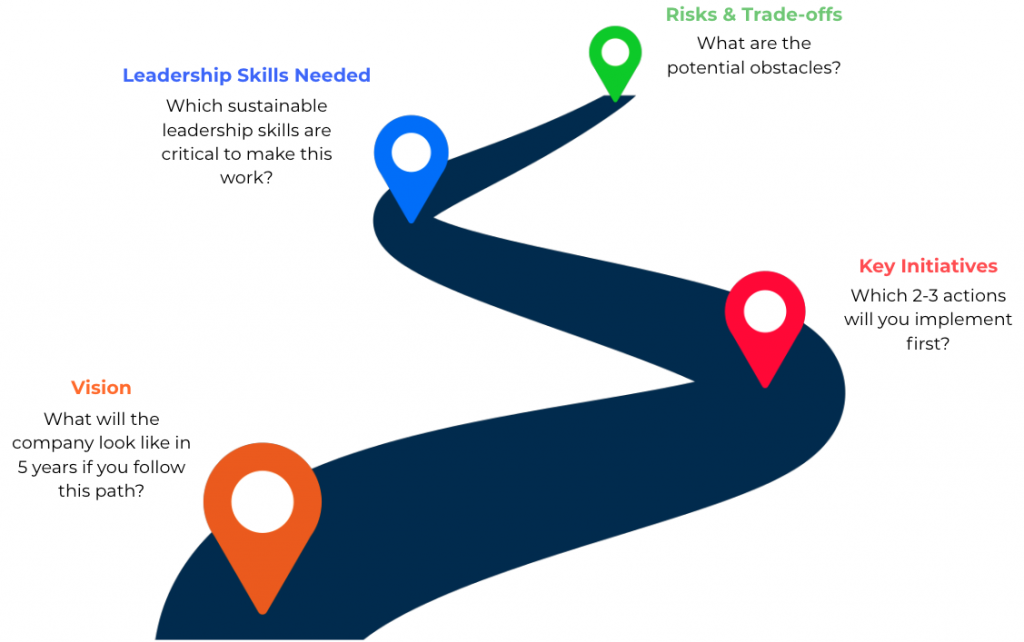
Once decisions are made, groups integrate them into a Sustainability Roadmap, illustrated in Figure 3.

05

Groups present their roadmaps. Facilitator compares different choices (e.g., some groups may prioritize short-term savings, others long-term resilience).

Figure 3
  • Al Jaghoub, J., Suleiman, A., Takshe, A. A., Moussa, S., Gilani, S. A. M., Sheikh, S., & Tantry, A. (2025). The role of innovation in waste management for enterprises: A critical review of the worldwide literature. Technology-Driven Business Innovation (Stud. in Systems, Decision and Control, Vol. 223, pp. 453–464). Springer. doi.org/10.1007/978-3-031-51997-0_38

  • Claremont Lincoln University. (n.d.). What is sustainability leadership? Retrieved August 13, 2025, from claremontlincoln.edu/news-blog/what-is-sustainability-leadership

  • Ince, F. (2018). Leadership and sustainability: From the first to the second generation of SMEs ownership. In R. Perez-Uribe, C. Salcedo-Perez, & D. Ocampo-Guzman (Eds.), Handbook of

  • Research on Intrapreneurship and Organizational Sustainability in SMEs (pp. 1–22). IGI Global. doi.org/10.4018/978-1-5225-3543-0.ch002

  • Mansour, A., Al-Ahmed, H., Shajrawi, A., Alshaketheep, K., Alshurideh, M., & Deeb, A. (2025).
    Sustainable leadership in family-owned businesses: The practice of searching profitability and evaluating the business’ effects on the environment. An Najah University Journal for Research – B (Humanities), 39(4), Article 7. doi.org/0247.39.4.2420

  • Suriyankietkaew, S., Krittayaruangroj, K., & Iamsawan, N. (2022). Sustainable leadership practices and competencies of SMEs for sustainability and resilience: A community-based social enterprise study. Sustainability, 14(10), 5762. doi.org/10.3390/su14105762

  • Tantry, A., & Puri Singh, A. (2016). A study of psychological hardiness across different professions of Kashmir (J&K), India. International Journal of Advanced Research, 4(2), 1258–1263.

  • Tantry, A., Gilani, S. A. M., Al Sabbah, S., Sitinjak, C., Khan, N., Mulla, T., Askri, S., … Bhat, R. M. (2025). Sustainable leadership styles adopted by small businesses in the UAE during and post COVID-19. Discover Sustainability, 6, Article 570. doi.org/10.1007/s43621-025-01426-z