
1. Key Concepts
Economic and social responsibility
Financial goals for economic sustainability. As business owners, a controlling family has the financial goal for the business to ensure that the business not only survives but also grows the value of the family and business wealth.
Although this financial goal is similar to owners of nonfamily businesses, your family’s financial goals are not limited to growing wealth for a short period of time.
Instead, your goals may be long termed by aiming for economic sustainability, i.e., family wealth growing and accumulating over generations.
Nonfinancial goals and social sustainability. The unique nature of family businesses lies in the controlling family’s emphasis on their nonfinancial goals.
The concept, socioemotional wealth (SEW), captures such nonfinancial goals that satisfy the family’s affective needs (Gomez-Mejia et al., 2007).
Socioemotional wealth (SEW)
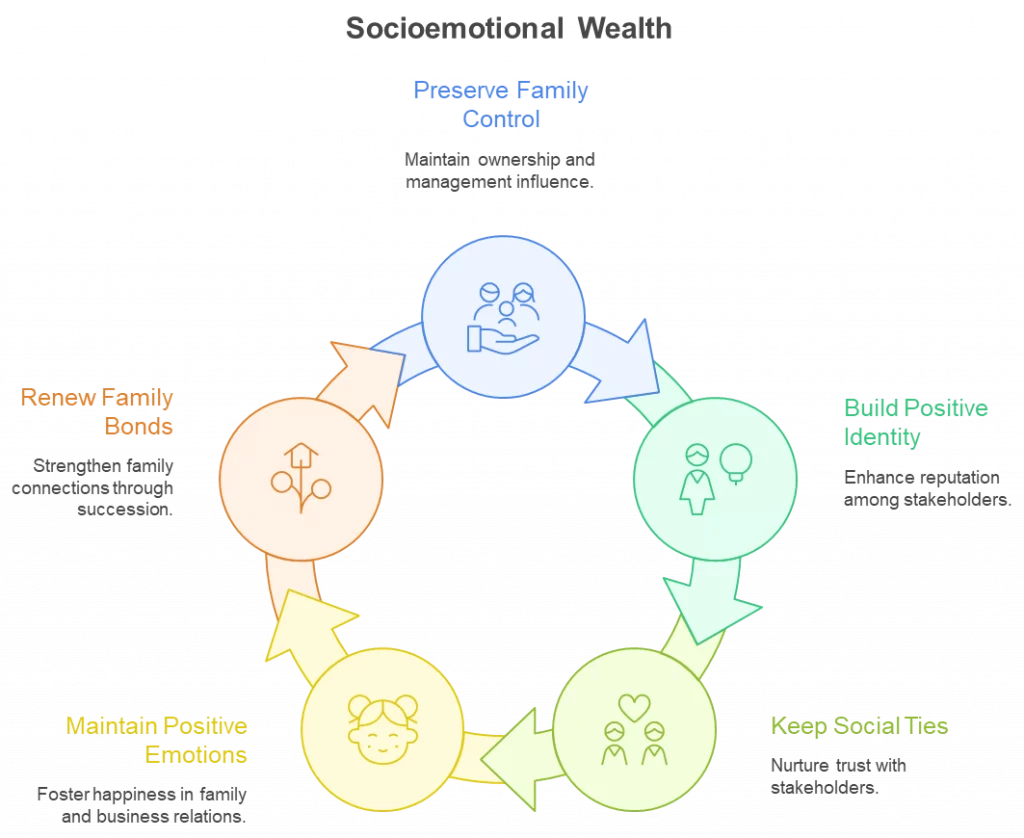
The most common SEW goals (Berrone et al., 2012) include the family’s attention to
- preserve the family control and influence in the firm, such as ownership and management
- build positive identity and name perceived by both family and nonfamily stakeholders
- keep the social ties with stakeholders who trust the family,
- maintain positive emotions for being in relation to the family and the business, and
- renew the family bonds in the business via intrafamily succession
These nonfinancial goals center the controlling family on creating social values that they can keep and transfer over generations (Vazquez, 2018).
Trade-off between economic and social sustainability
When family firms consider financial and nonfinancial goals in making sustainability decisions, you may sometimes experience a trade-off among these goals and how you should approach economic vs. social sustainability.
Specifically, if your family is mainly concerned about the economic sustainability in terms of maximizing the growth of the family wealth and assets, you may potentially regard social sustainability as costly investments that do not necessarily pay off in the long run (Miller & Le Breton-Miller, 2021).
For instance, our cases of S & A Sofokleous Bakery (Cyprus), Orditura Paola di Grazzini Fausto (Italy), and Satturn Holešov (Czech Republic) have all expressed concerns of high initial investment costs in sustainable infrastructure, such as switching to electrical delivery vehicles and building a photovoltaic plant, and the high annual fees in maintaining environmental certifications, especially when they are not certain whether these practices will achieve the long-term impacts they expect, such as better energy efficiency and improved customer relationships.
How to evaluate your goals effectively to make sustainability decisions?
When your family struggles between goals in determining which sustainability to prioritize, it is important to first have an open communication about each member’s goal.
This is particularly important because different members may put different weights on the financial and nonfinancial goals and you may want to find what these members share in common to better utilize the family resources to achieve its sustainable impacts.
For example, several of our cases have highlighted individual members, particular next-generation members, and their goals and passion for environmental stewardship as the main drivers for their families to start considering investing in sustainable practices, such as the push of S & A Sofokleous Bakery (Cyprus) for more ecofriendly packaging for the products and the adoption of Grupo El Castillo (Spain) for better recycling programs to reduce office wastes by employees and product wastes by customers.
Similarly, in Mårdskog & Lindkvist (Sweden) , the next-generation member has strong awareness for environmental sustainability and negotiates with the current-generation leader to consider taking sustainable initiatives, such as switching from fossil fuels to biogas.
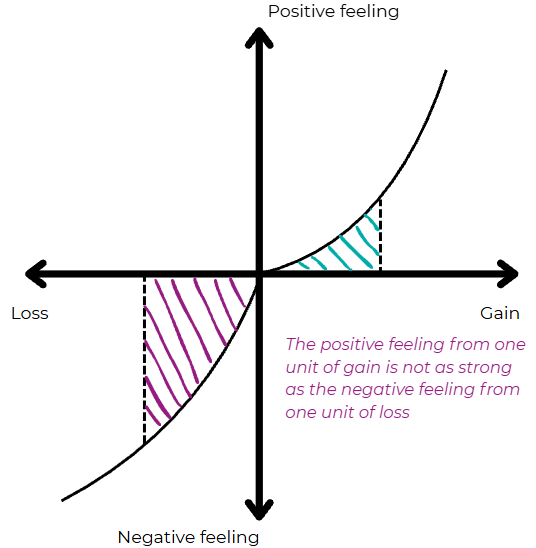
When exploring the common goals among your family members, you may want to see how your family members evaluate financial and nonfinancial losses differently.
In particular, human beings tend to consider loss more serious, such as one dollar of financial loss may bring stronger feelings than one dollar of financial gain does, even if the amount of gain and loss is the same (Wiseman & Gomez-Mejia, 1998).
In family businesses, the evaluation will further need to consider the gain and loss of socioemotional wealth, such as control, emotional feeling, and family reputation.
Particularly, some of your family members may think the loss of such socioemotional wealth has a more serious implication than the financial loss (Gomez-Mejia et al., 2007), especially the short-term financial loss.
In this case, your family members may be willing to invest initial costs or the annual fees to avoid the long-term loss of social values.
For instance, Orditura Paola di Grazzini Fausto (Italy) justifies its annual fees for the environmental certification to avoid losing customers and supply chain partners who require such a certification.
The other cases choose to make the initial investment in sustainable practices, such as:
Plojhar (Czech Republic) replacing fossil fuels with
compressed natural gas for its transportation vehicles
Konstanta MF (Ukraine) and Satturn Holešov (Czech Republic) installing solar panels on their sites, to avoid the future uncertainty, such as the volatile prices and supply of fossil fuels and electricity from the existing national infrastructure.
2. Goal Evaluation Activity
Here are some questions to help your family understand each other’s goals, particularly nonfinancial goals (Berrone et al., 2012).
How would you evaluate the following goals? (1 = not very important and 7 = very important)
Control and influence
The majority of shares are owned by family members
Family members exert control over the firm’s strategic decisions
Most executive positions are occupied by family members
Nonfamily managers and directors are named by family members
Board of directors is mainly composed of family members
Preservation of family control and independence are important goals
Identity
Family members have a strong sense of belong to the family business
Family members feel that the family business’ success is their own success
The family business has a great deal of personal meaning for family members
Customers often associate the family name with the family business’ products/services
Social ties
My family business is very active in promoting community activities
Nonfamily employees are treated as part of the family
Contractual relationships are mainly based on trust and norms of reciprocity
Building strong relationships with others, e.g., firms, associations, and government, is important
Contract with suppliers are based on enduring long-term relationships
Emotions
Emotions often affect decision-making process in the family business
Protecting family members’ welfare is critical, apart from their personal contributions to the business
Emotional bonds between family members are very strong
Affective considerations are often as important as economic considerations
Strong emotional ties among family members help us maintain a positive self-concept
Family members feel warmth for each other
Intrafamily succession
Continuing the family legacy and tradition is an important goal
Family owners are less likely to evaluate their investment on a short-term basis
Family members would be unlikely to consider selling the family business
Successful business transfer to the next generation is an important goal
3. Conclusion
These discussions are important to determine how your family will allocate resources to approach sustainability strategies.
As each family has different priorities on these goals, there is no universal approach shared by all families. Some may choose to use relation-based approaches by focusing on close stakeholders in the local communities, while some may scale up their sustainability practices targeting all stakeholders affected by their operations in different countries (Hsueh et al., 2023).
4. Self-Assessment
5. Resources and Further Reading
- Visualization of your goals via the Family Business Investigator provided by the University of St. Gallen: Family Business Navigator
- The questionnaire to evaluate your nonfinancial goals: Berrone, P., Cruz, C., & Gomez-Mejia, L. R. (2012).
Socioemotional wealth in family firms: Theoretical dimensions, assessment approaches, and agenda for future research. Family Business Review, 25(3), 258–279. doi.org/0894486511435355
6. References
Berrone, P., Cruz, C., & Gomez-Mejia, L. R. (2012). Socioemotional wealth in family firms: Theoretical dimensions, assessment approaches, and agenda for future research. Family Business Review, 25(3), 258–279. doi.org/0894486511435355
Gomez-Mejia, L. R., Haynes, K. T., Núñez-Nickel, M., Jacobson, K. J. L., & Moyano-Fuentes, J. (2007). Socioemotional wealth and business risks in family-controlled firms: Evidence from spanish olive oil mills. Administrative Science Quarterly, 52(1), 106–137. doi.org/10.2307/20109904
Hsueh, J. W.-J., De Massis, A., & Gomez-Mejia, L. (2023). Examining heterogeneous configurations of socioemotional wealth in family firms through the formalization of corporate social responsibility strategy. Family Business Review, 36(2), 172–198. doi.org/08944865221146350
Miller, D., & Le Breton Miller, I. (2021). Family firms: A breed of extremes? Entrepreneurship Theory and Practice, 45(4), 663–681.
doi.org/1042258720964186Vazquez, P. (2018). Family business ethics: At the crossroads of business ethics and family business. Journal of Business Ethics, 150(3),
691–709. doi.org/s10551-016-3171-1Wiseman, R. M., & Gomez-Mejia, L. R. (1998). A behavioral agency model of managerial risk taking. Academy of Management Review,
23(1), 133–153. doi.org/AMR.1998.192967