
1. Key Concepts
Sustainability reporting and certifications
Reporting and certifications are one of the corporate communication strategies to stakeholders concerning an organization’s ESG practices.
Reporting is meant to systematically disclose the (ESG) risks and actions that an organization experiences in its operational process

Certifications represent third-party verifications of the organization’s ESG practices and their compliance with the regulation or industry norms (Pope & Lim, 2020)
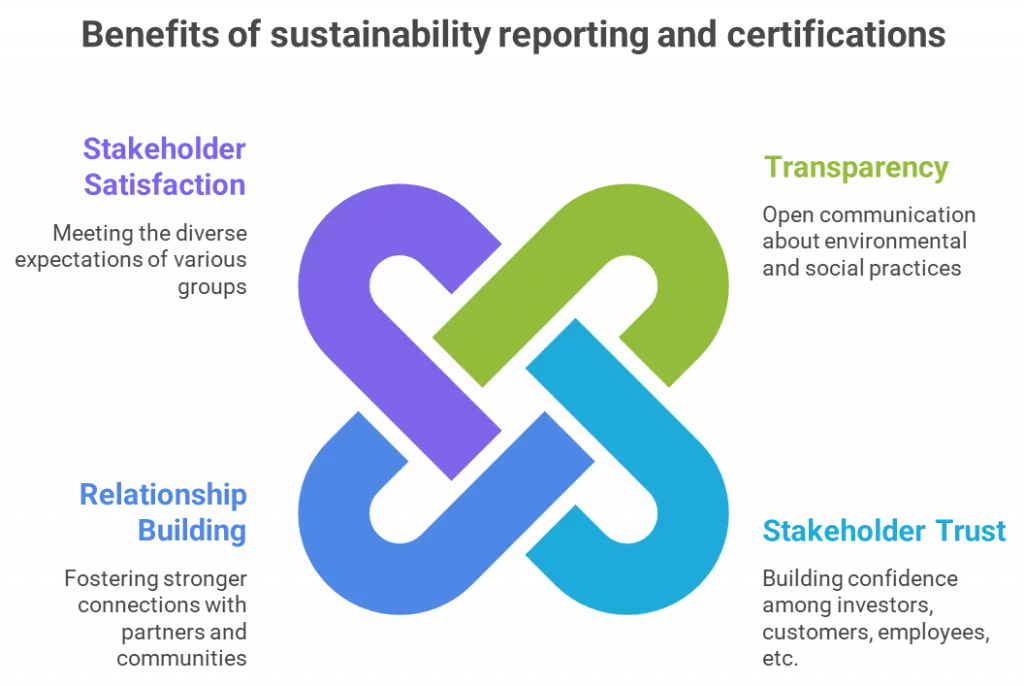
By disclosing and verifying ESG practices, you can better build trust from their stakeholders, such as customers, suppliers, and investors, who are not involved in the firm operation and do not necessarily know what the firm is actually doing.
This concern is particularly relevant for family businesses like yours, as stakeholders tend to be concerned that your family may share important information mainly among yourselves rather than openly sharing with nonfamily members (Hsueh, 2018).
Response to stakeholders
In addition to proactively communicating ESG practices to external stakeholders, your family may also face pressure from those stakeholders to disclose more information and to obtain more verifications (Morsing & Spence, 2019).
For instance, if other competitors are adopting the same certification, your customers and suppliers may expect you to do the same; otherwise, you may lose such business partnerships and opportunities when they will resort to competitors with certification, as the family of KSL Trading (Sweden) has shared in their case.
Similarly, our case, Orditura Paola di Grazzini Fausto (Italy), also encounters the pressure in the textile sector in which suppliers are expected to obtain certifications for their ingredients and products. Meeting or even exceeding these stakeholders’ demands can grant your family business positive evaluations that attract more stakeholders’ interactions to benefit your business operations (He et al., 2025).
Common reporting frameworks
When your family wants to engage in such communication strategies, you may start with the most common reporting frameworks and/or certifications.
The most common reporting framework is Global Reporting Initiative (GRI), which is a dominant framework for sustainability reporting as more than 14,000 organizations in over 100 countries have adopted this framework to guide their sustainability reporting.
However, family businesses in EU may need to pay attention to European Sustainability Reporting Standards (ESRS), which will be the guiding framework for companies’ sustainability reporting in compliance with EU CSRD starting in 2025.
Diverse certifications
In comparison to the dominance of these reporting frameworks, you may encounter more diversity in sustainability certifications. The common ones include
(1) ISO 14001, which is an international standard for verifying the environmental management system an organization has to control and improve its environmental performance. Our cases of Aveflor (Czech Republic) and Grupo El Castillo (Spain) have adopted ISO 14001 to improve their environmental performance, particularly waste management among employees and customers;
(2) Eco-Management and Audit Scheme (EMAS), which is similar to ISO 14001 but focuses more on the environmental management system of organizations based in EU;
(3) B Corp Certification is another standard that looks at not only environmental performance of an organization but also its social performance and transparency.
In addition to these comprehensive certifications, your family may target certifications for specific aspects of sustainability practices.
For instance, our case, Plojhar (Czech), adopts the Forest Stewardship Council Certification to monitor its uses of timber-related products.
The case of Orditura Paola di Grazzini Fausto (Italy) follows the Global Recycled Standard to improve its recycling of materials and products.
Challenges
The diversity of reporting frameworks and certifications may sometimes bring several challenges to your family business, especially if it’s a SME.
As compliance with each framework and/or certification requires time and resources, your family business may not be able to follow several frameworks and certifications at the same time.
In particular, if your family has businesses in different countries, legal frameworks in different settings may sometimes even contradict each other, as Aveflor (Czech Republic) has experienced, creating difficulty in developing a company-wide, consistent environmental management system.
Similarly, Essem Design (Sweden) has businesses in different industry sectors, where each sector has its own certification. Moreover, as certain reporting frameworks and/or certifications require detailed monitoring and calculation, such as Scope 3 emissions along the whole supply chain, the controlling family of Essem Design is overwhelmed by the additional administrative workloads for sustainability reporting on top of their normal operational workload.
Our cases have shared several tips to overcome these challenges.
First, when facing diverse frameworks and certifications, your family may want to evaluate which one is most important and directly relevant to your business operation.
Given the limited resources, Essem Design (Sweden) decides to first focus on obtaining the certification for the sector in which their major customers are located and thus contributes to most of their revenue.
However, if your family firm evaluates that several frameworks and/or certifications are equally important, you may need to dedicate a person who can study those requirements in detail, i.e., developing an internal expert on the subject.
Aveflor (Czech Republic) has employed an employee mainly to understand the regulatory difference between countries. This person engages in detailed discussion with government officials to help the controlling family introduce appropriate sustainable practices, such as setting up the photovoltaic power plant and wastewater treatment plant.

If your family does not have resources to develop an internal expert, you can rely on collaboration with external partners.
For instance, Grupo El Castillo (Spain) has offered environmental training to its customers, who can then help it implement sustainable practices such as waste reduction to fulfill the requirement of related certifications.
Similarly, KSL Trading (Sweden) has trained their customers to help provide input to prepare their sustainability reporting.
Moreover, they also collaborate with suppliers to learn from each other, such as how to collect input from other customers and suppliers and how to calculate the emissions.
Close collaboration with other stakeholders enables these family firms to utilize collective resources and knowledge to fulfill the demands of their sustainability reporting and certifications.
In conclusion, sustainability reporting and certifications gradually become inevitable for family businesses due to the increasing demands of key stakeholders, such as the government, industry, and customers, who need information about your family firm’s sustainability activities to develop their trust and willingness to work with you.
As there are many different reporting frameworks and certification standards, your family may not have enough resources to pursue all of them.
Therefore, you may need to discuss with your family members:
which one to prioritize
which person is designated for this task
whether you would like to collaborate with your external partners for this task
You can use these assessment questions to guide your family’s discussion.
- Who are your key stakeholders and what are their expectations for sustainability reporting and/or certifications?
- Which expectation is most relevant to your family and business?
- How many resources, e.g., financial resources, human resources, and time, does your family have to pursue this most relevant sustainability reporting framework and/or certification?
- How would your family evaluate both the short-term and long-term cost and benefits for pursuing this particular reporting framework and/or certification?
- Who will be the person responsible for implementing the reporting and/or certification? Does this person have the relevant knowledge? How can you support this person to prepare for the implementation?
- How will you evaluate the effectiveness of your sustainability reporting and/or certification and decide whether to continue the practices?
2. Self-Assessment
3. Resources and Further Reading
- European Commission. Corporate Sustainability Reporting Directive (CSRD).
finance.ec.europa.eu/capital-markets-union-and-financial-markets/company-reporting-and-auditing/company-reporting/corporate -sustainability-reporting_en - European Commission. Voluntary Standard for small and medium-sized enterprises (VSME). finance.ec.europa.eu
- Global Reporting Initiative (GRI):
- Content Index Template. globalreporting.org
- Licensed Software and Tools Partners in different countries. globalreporting.org
- International Organization for Standardization: Standards on different aspects of environmental sustainability. iso.org/sectors/environment
- Eco-Management and Audit Scheme (EMAS): Tools. green-forum.ec.europa.eu/green-business/emas/emas-resources/emas-tools_en
- B Lab Europe: How to become a B Corp. bcorporation.eu/become-a-b-corp/how-to-become-a-b-corp
4. References
- Carè, R., Agnese, P., Cerciello, M., & Taddeo, S. (2025). Does it pay off to disclose sustainability information? The effect of ESG disclosure on ESG controversies in European banks. Business Strategy and the Environment, 34, 3294–3310. doi.org/10.1002/bse.4150
- He, H., Chen, Y., Guo, R., He, L., & Wan, H. (2025). Cost of vagueness: Stakeholders’ responses to firms’ ESG information. Journal of Business Ethics. doi.org/10.1007/s10551-025-06001-0
- Hsueh, J. W.-J. (2018). Governance structure and the credibility gap: Experimental evidence on family businesses’ sustainability reporting. Journal of Business Ethics, 153(2), 547–568. doi.org/10.1007/s10551-016-3409-y
- Morsing, M., & Spence, L. J. (2019). Corporate social responsibility (CSR) communication and small and medium sized enterprises: The governmentality dilemma of explicit and implicit CSR communication. Human Relations, 72(12), 1920–1947.
doi.org/0018726718804306 - Philippe, D., & Durand, R. (2011). The impact of norm-conforming behaviors on firm reputation. Strategic Management Journal, 32(9), 969–993. doi.org/10.1002/smj.919
- Pope, S., & Lim, A. (2020). The governance divide in global corporate responsibility: The global structuration of reporting and certification frameworks, 1998–2017. Organization Studies, 41(6), 821–854. doi.org/0170840619830131