|

Cross-organisation Collaboration for Sustainability

Module 10.

Cross-organisation Collaboration for Sustainability

Takeaways

  • Understand how cross-organisation collaboration enables sustainability, innovation, and resilience in family businesses
  • Recognise the main forms of collaboration and their strategic value for green transition and compliance
  • Identify potential partners and define first, low-risk steps toward a sustainability-oriented collaboration

Aim of this module

This module aims to help family businesses understand why and how collaboration matters in the green transition.

By the end of the module, learners will be able to:

  • Understand how cross-organisation collaboration supports sustainability and resilience in family businesses
  • Recognise different forms of collaboration across value chains, territories, and institutions
  • Identify the concrete benefits of partnerships for innovation, compliance, and competitiveness
  • Explore practical examples of collaborative green practices
  • Reflect on first steps to activate or strengthen partnerships within their own ecosystem

Introduction

Environmental challenges – from resource scarcity to supply chain fragility – are too complex to face alone.

For small and family businesses, cross-organisational collaboration is essential to advancing the green transition.

Collaboration enables companies to pool knowledge, share tools, access specialised expertise, and take joint action toward sustainable innovation, certified processes, and greener practices. Family businesses can collaborate with SMEs, larger firms, associations, universities, public authorities, or NGOs to multiply impact and opportunities.

Sustainability is no longer an individual effort; it is a shared pathway toward competitiveness and community value.

Cross-organisational collaboration is a critical driver of sustainability, especially for small and family-owned firms. By working with businesses, institutions, research centres, or civil society, companies can access new capabilities, share resources, and develop more effective sustainability plans.

Contents of this module

No business – particularly small and family-owned – can transition toward sustainability alone. The complexity of regulations, environmental constraints, and market expectations requires a collaborative mindset.

Cross-organisational collaboration helps join forces, reduce costs, and unlock innovation, competitiveness, and resilience.

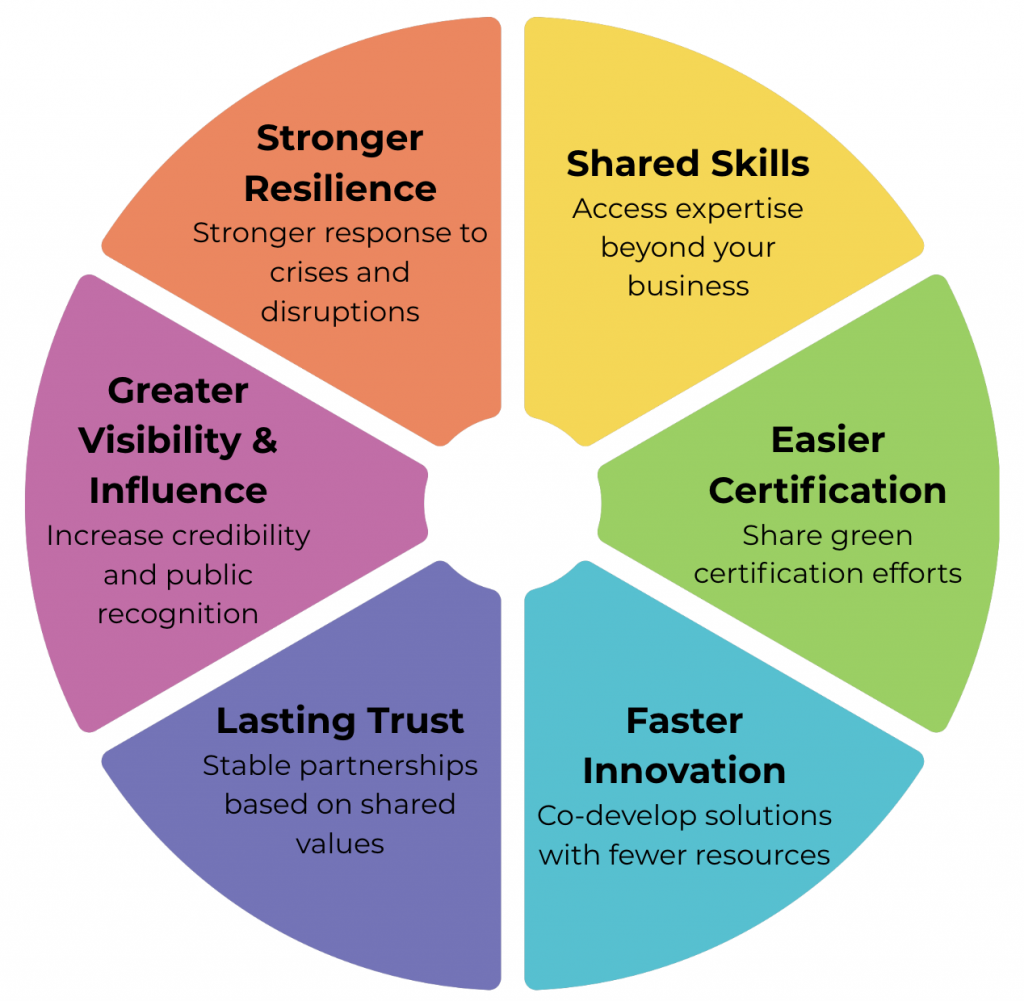
The infographic highlights six key benefits of cross-organisational collaboration.

Horizontal collaboration

Working with peer businesses in the same sector or region: sharing best practices, tools, infrastructures and pursuing certifications together.

Vertical collaboration

Collaboration with suppliers, manufacturers, distributors, or clients: aligning sustainability objectives along the value chain, reducing waste, adopting eco-materials, and applying traceability systems.

Institutional collaboration

Collaboration with municipalities, universities, or public agencies: gaining knowledge, funding, visibility, and participating in local development and innovation initiatives.

Cluster & network collaboration

Joining forces with associations, cooperatives, or innovation clusters: boosting scale, collective initiatives, funding applications, and policy representation.

Reflective activity

Map your collaboration landscape:

Which actors (companies, institutions, organisations) in your sector or region are already working on sustainability?

Essem Design - Sweden

Essem Design is a family-owned furniture company with a circular mindset since 1937.

It collaborates with local designers, material suppliers, and logistics providers to reduce environmental impact and support the regional economy.

The company also works with certification bodies and testing institutions to comply with multiple standards (ISO, environmental product declarations). Collaboration simplifies complex certification processes and meets customer expectations.

Satturn Holešov - Czech Republic

Satturn is a family-run tech company collaborating with universities and government ministries to develop decentralised wastewater treatment systems and environmental telemetry. These innovations are used in municipalities and hospitals nationwide.

Satturn has also implemented eco-innovations on its premises (PV plant, rainwater reuse, thermal insulation), functioning as living labs. Additionally, it participates in creating a local energy community with the municipality, businesses, and citizens.

Reflective activity

Collaboration Canvas:
  • Who are 3 potential partners in your value chain or territory with whom you could explore collaboration?
  • Which sustainability challenge could you address together?
  • What form of collaboration would be most useful (technical, logistical, promotional, institutional)?
  • What would be a first step to initiate that partnership?

Sustainability cannot be achieved in isolation. Collaboration helps family businesses amplify efforts, share risks, and co-create green solutions. It provides access to knowledge, economies of scale, and visibility, while strengthening long-term commitment to sustainability.

Work Together

Share knowledge and resources

Be Strategic

Align goals and priorities

Leverage networks

Multiply opportunities

Build credibility

Increase trust and visibility

Start small ⟶ Big Impact

Small alliances, real change

Collaboration is a journey – not a single action

Next steps

  • Map local and value-chain actors.
  • Identify shared sustainability goals or challenges.
  • Reach out and propose a simple, low-risk collaboration idea.
  • Document results and scale up what works.
  • [Dembek, K., Singh, P., & Bhakoo, V. (2016). Creating shared value: A systematic review, synthesis and research agenda. International Journal of Management Reviews, 18(2), 167–191. doi.org/10.1111/ijmr.12068
  • European Commission. (2020). An SME Strategy for a sustainable and digital Europe. Brussels. commission.europa.eu
  • Family Business Network (FBN). (2022). Collaborating for Sustainable Growth Toolkit. Internal publication.
  • OECD. (2023). Greening SMEs for sustainability and competitiveness. Paris: OECD Publishing. oecd.org/industry/greening-smes.htm
  • Porter, M. E., & Kramer, M. R. (2011). Creating shared value: How to reinvent capitalism—and unleash a wave of innovation and growth. Harvard Business Review, 89(1–2), 62–77. hbr.org/2011/01/the-big-idea-creating-shared-value
  • United Nations. (2015). Sustainable Development Goals. Goal 17: Partnerships for the Goals. sdgs.un.org/goals/goal17